You don’t have to use the word in your poem, you can just use it as inspiration.
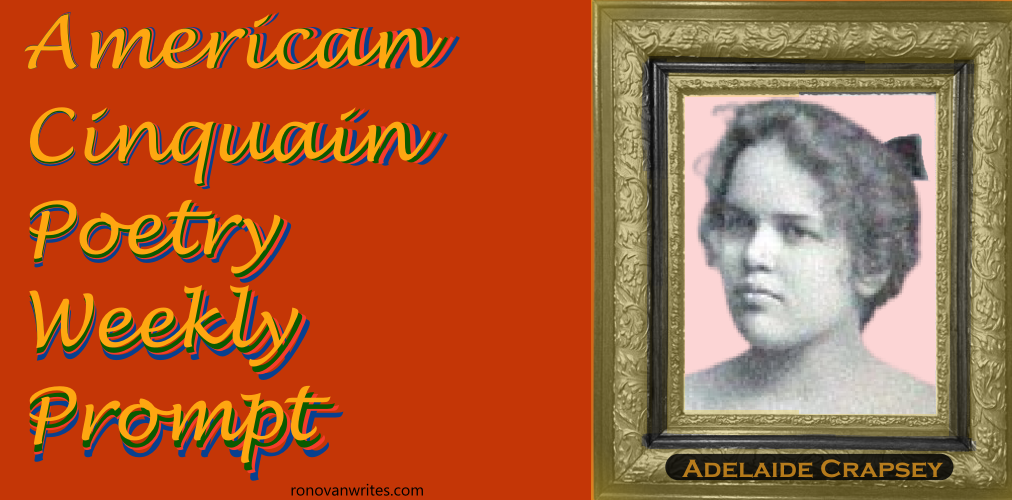
The Amerian Cinquain style is named as such because of it’s creator, the American poet Adelaide Crapsey. Learn about Adelaide and her short but productive life here. Creative, brilliant, and tragedy.
Yes, there is kind of a way of the madness of the poetry form, but you really just use the structure to create what you want in order to get your message across. There are examples of Adelaide Crapsey’s work below.
The Cinquain or more specifically the American Cinquain.
My Example:
Old Days
See how
The sun rises,
Breaking over beauty,
Filling the senses with heaven
Then fades.
You can see the pattern above is as follows…
THE STRUCTURE
5 Lines with each a given number of syllables as
2
4
6
8
2
An iambic foot with the stresses by line being
1
2
3
4
1
For the first line of the poem there will be two syllables with one stressed syllable and that one being the second one, which establishes the pattern.
The Cinquain most commonly used is the American Cinquain created by Adelaide Crapsey. Although she did not write down specific rules for composing one of her Cinquains, we have a form from people who have studied her poetry and have found commonalities in her works, those being the syllable and iambic foot, stresses pattern, although the iambic foot is not a requirement. Think of iambic foot and meter as the beat of music and the poem. Every other syllable is the beat.
THE CONTENT
As much as structure dictates an American Cinquain, the content and descriptive nature of the poem is just as important. Emotion. Nature. Event. Idea. All of those can be what brings words to the poem. If you’re not accustomed to cinquain yet, or your idea of a poem is big, write your poem as long as it needs to be to get your story down. Then you start zeroing in on structure. Then you turn that original idea and those original words into such concise and descriptive wording that in just 22 syllables you tell your story.
As you tell the story, remember that often, and usually, the last line flips the story you’ve told. A negative poem ends with a positive, a positive with a negative. A story of anger ends in peace. Oppressed ends in freedom.
Using my example, I tell a story of could be an actual sunrise, emotions, or an event. It’s a pleasant and serene, inspiring tale, then with the ending it all disappears. Yes, a sunrise disappears, an event ends, the joyful emotions of love may end in total darkness and depression.
Two Adelaide Crapsey Cinquain poems:
November Night
Listen . . .
With faint dry sound,
Like steps of passing ghosts,
The leaves, frost-crisp’d, break from the trees
And fall.
Trapped
Well and
If day on day
Follows and weary year
On year . . . and ever days and years . . .
Well?
LINKING BACK TO THE PROMPT:
One way to increase interest in prompt challenges is to link back or pingback to the prompt when you write your response on your blog. This can also have a couple or more extra visits to your post.
Click HERE to find out how to do a Pingback. It’s a post I created a long time ago. It includes an image showing you how to do it.
Some people like to copy and paste the challenge image into their posts. That’s okay with me.
© 2025- Ronovan Hester Copyright reserved. The author asserts his moral and legal rights over this work.
 ronovanwrites