Cinquain Poetry Prompt 11: OVERCOME is your inspiration.

You don’t have to use the word in your poem, you can just use it as inspiration.

Yes, there is kind of a way of the madness of the poetry form, but you really just use the structure to create what you want in order to get your message across. There are examples of Adelaide Crapsey’s work below. She’s the one who created this style.

The Cinquain or more specifically the American Cinquain.

My Example:

Old Days

See how
The sun rises,
Breaking over beauty,
Filling the senses with heaven
Then fades.

You can see the pattern above is as follows…

THE STRUCTURE

5 Lines with each a given number of syllables as

2
4
6
8
2

An iambic foot with the stresses by line being

1
2
3
4
1

For the first line of the poem there will be two syllables with one stressed syllable and that one being the second one, which establishes the pattern.

The Cinquain most commonly used is the American Cinquain created by Adelaide Crapsey. Although she did not write down specific rules for composing one of her Cinquains, we have a form from people who have studied her poetry and have found commonalities in her works, those being the syllable and iambic foot, stresses pattern, although the iambic foot is not a requirement. Think of iambic foot and meter as the beat of music and the poem. Every other syllable is the beat.

THE CONTENT

As much as structure dictates an American Cinquain, the content and descriptive nature of the poem is just as important. Emotion. Nature. Event. Idea. All of those can be what brings words to the poem. If you’re not accustomed to cinquain yet, or your idea of a poem is big, write your poem as long as it needs to be to get your story down. Then you start zeroing in on structure. Then you turn that original idea and those original words into such concise and descriptive wording that in just 22 syllables you tell your story.

As you tell the story, remember that often, and usually, the last line flips the story you’ve told. A negative poem ends with a positive, a positive with a negative. A story of anger ends in peace. Oppressed ends in freedom.

Using my example, I tell a story of could be an actual sunrise, emotions, or an event. It’s a pleasant and serene, inspiring tale, then with the ending it all disappears. Yes, a sunrise disappears, an event ends, the joyful emotions of love may end in total darkness and depression.

Two Adelaide Crapsey Cinquain poems:

November Night

Listen . . .
With faint dry sound,
Like steps of passing ghosts,
The leaves, frost-crisp’d, break from the trees
And fall.

Trapped

Well and
If day on day
Follows and weary year
On year . . . and ever days and years . . .
Well?

LINKING BACK TO THE PROMPT:

One way to increase interest in prompt challenges is to link back or pingback to the prompt when you write your response on your blog. This can also have a couple or more extra visits to your post.

Click HERE to find out how to do a Pingback. It’s a post I created a long time ago. It includes an image showing you how to do it.

Some people like to copy and paste the challenge image into their posts. That’s okay with me.
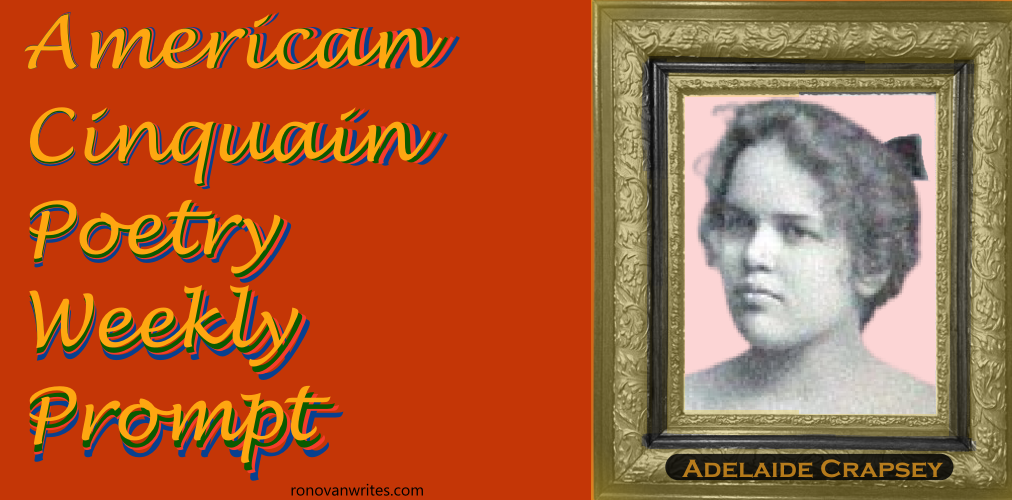
American Cinquain Poetry Prompt

Enter your email address to subscribe to this blog and receive notifications of new posts by email.

© 2025- Ronovan Hester Copyright reserved. The author asserts his moral and legal rights over this work.

Cinquain Poetry Prompt 10: TREASURE is your inspiration.

You don’t have to use the word in your poem, you can just use it as inspiration.

Yes, there is kind of a way of the madness of the poetry form, but you really just use the structure to create what you want in order to get your message across. There are examples of Adelaide Crapsey’s work below. She’s the one who created this style.

The Cinquain or more specifically the American Cinquain.

My Example:

Old Days

See how
The sun rises,
Breaking over beauty,
Filling the senses with heaven
Then fades.

You can see the pattern above is as follows…

THE STRUCTURE

5 Lines with each a given number of syllables as

2
4
6
8
2

An iambic foot with the stresses by line being

1
2
3
4
1

For the first line of the poem there will be two syllables with one stressed syllable and that one being the second one, which establishes the pattern.

The Cinquain most commonly used is the American Cinquain created by Adelaide Crapsey. Although she did not write down specific rules for composing one of her Cinquains, we have a form from people who have studied her poetry and have found commonalities in her works, those being the syllable and iambic foot, stresses pattern, although the iambic foot is not a requirement. Think of iambic foot and meter as the beat of music and the poem. Every other syllable is the beat.

THE CONTENT

As much as structure dictates an American Cinquain, the content and descriptive nature of the poem is just as important. Emotion. Nature. Event. Idea. All of those can be what brings words to the poem. If you’re not accustomed to cinquain yet, or your idea of a poem is big, write your poem as long as it needs to be to get your story down. Then you start zeroing in on structure. Then you turn that original idea and those original words into such concise and descriptive wording that in just 22 syllables you tell your story.

As you tell the story, remember that often, and usually, the last line flips the story you’ve told. A negative poem ends with a positive, a positive with a negative. A story of anger ends in peace. Oppressed ends in freedom.

Using my example, I tell a story of could be an actual sunrise, emotions, or an event. It’s a pleasant and serene, inspiring tale, then with the ending it all disappears. Yes, a sunrise disappears, an event ends, the joyful emotions of love may end in total darkness and depression.

Two Adelaide Crapsey Cinquain poems:

November Night

Listen . . .
With faint dry sound,
Like steps of passing ghosts,
The leaves, frost-crisp’d, break from the trees
And fall.

Trapped

Well and
If day on day
Follows and weary year
On year . . . and ever days and years . . .
Well?

LINKING BACK TO THE PROMPT:

One way to increase interest in prompt challenges is to link back or pingback to the prompt when you write your response on your blog. This can also have a couple or more extra visits to your post.

Click HERE to find out how to do a Pingback. It’s a post I created a long time ago. It includes an image showing you how to do it.

Some people like to copy and paste the challenge image into their posts. That’s okay with me.

American Cinquain Poetry Prompt

Enter your email address to subscribe to this blog and receive notifications of new posts by email.

© 2025- Ronovan Hester Copyright reserved. The author asserts his moral and legal rights over this work.

Cinquain Poetry Prompt 9: BRAVE is your inspiration.

You don’t have to use the word in your poem, you can just use it as inspiration.

Yes, there is kind of a way of the madness of the poetry form, but you really just use the structure to create what you want in order to get your message across. There are examples of Adelaide Crapsey’s work below. She’s the one who created this style.

The Cinquain or more specifically the American Cinquain.

My Example:

Old Days

See how
The sun rises,
Breaking over beauty,
Filling the senses with heaven
Then fades.

You can see the pattern above is as follows…

THE STRUCTURE

5 Lines with each a given number of syllables as

2
4
6
8
2

An iambic foot with the stresses by line being

1
2
3
4
1

For the first line of the poem there will be two syllables with one stressed syllable and that one being the second one, which establishes the pattern.

The Cinquain most commonly used is the American Cinquain created by Adelaide Crapsey. Although she did not write down specific rules for composing one of her Cinquains, we have a form from people who have studied her poetry and have found commonalities in her works, those being the syllable and iambic foot, stresses pattern, although the iambic foot is not a requirement. Think of iambic foot and meter as the beat of music and the poem. Every other syllable is the beat.

THE CONTENT

As much as structure dictates an American Cinquain, the content and descriptive nature of the poem is just as important. Emotion. Nature. Event. Idea. All of those can be what brings words to the poem. If you’re not accustomed to cinquain yet, or your idea of a poem is big, write your poem as long as it needs to be to get your story down. Then you start zeroing in on structure. Then you turn that original idea and those original words into such concise and descriptive wording that in just 22 syllables you tell your story.

As you tell the story, remember that often, and usually, the last line flips the story you’ve told. A negative poem ends with a positive, a positive with a negative. A story of anger ends in peace. Oppressed ends in freedom.

Using my example, I tell a story of could be an actual sunrise, emotions, or an event. It’s a pleasant and serene, inspiring tale, then with the ending it all disappears. Yes, a sunrise disappears, an event ends, the joyful emotions of love may end in total darkness and depression.

Two Adelaide Crapsey Cinquain poems:

November Night

Listen . . .
With faint dry sound,
Like steps of passing ghosts,
The leaves, frost-crisp’d, break from the trees
And fall.

Trapped

Well and
If day on day
Follows and weary year
On year . . . and ever days and years . . .
Well?

LINKING BACK TO THE PROMPT:

One way to increase interest in prompt challenges is to link back or pingback to the prompt when you write your response on your blog. This can also have a couple or more extra visits to your post.

Click HERE to find out how to do a Pingback. It’s a post I created a long time ago. It includes an image showing you how to do it.

Some people like to copy and paste the challenge image into their posts. That’s okay with me.

American Cinquain Poetry Prompt

Enter your email address to subscribe to this blog and receive notifications of new posts by email.

© 2025- Ronovan Hester Copyright reserved. The author asserts his moral and legal rights over this work.

Cinquain Poetry Prompt 8: RELEASED is your inspiration.

You don’t have to use the word in your poem, you can just use it as inspiration.

Yes, there is kind of a way of the madness of the poetry form, but you really just use the structure to create what you want in order to get your message across. There are examples of Adelaide Crapsey’s work below. She’s the one who created this style.

The Cinquain or more specifically the American Cinquain.

My Example:

Old Days

See how
The sun rises,
Breaking over beauty,
Filling the senses with heaven
Then fades.

You can see the pattern above is as follows…

THE STRUCTURE

5 Lines with each a given number of syllables as

2
4
6
8
2

An iambic foot with the stresses by line being

1
2
3
4
1

For the first line of the poem there will be two syllables with one stressed syllable and that one being the second one, which establishes the pattern.

The Cinquain most commonly used is the American Cinquain created by Adelaide Crapsey. Although she did not write down specific rules for composing one of her Cinquains, we have a form from people who have studied her poetry and have found commonalities in her works, those being the syllable and iambic foot, stresses pattern, although the iambic foot is not a requirement. Think of iambic foot and meter as the beat of music and the poem. Every other syllable is the beat.

THE CONTENT

As much as structure dictates an American Cinquain, the content and descriptive nature of the poem is just as important. Emotion. Nature. Event. Idea. All of those can be what brings words to the poem. If you’re not accustomed to cinquain yet, or your idea of a poem is big, write your poem as long as it needs to be to get your story down. Then you start zeroing in on structure. Then you turn that original idea and those original words into such concise and descriptive wording that in just 22 syllables you tell your story.

As you tell the story, remember that often, and usually, the last line flips the story you’ve told. A negative poem ends with a positive, a positive with a negative. A story of anger ends in peace. Oppressed ends in freedom.

Using my example, I tell a story of could be an actual sunrise, emotions, or an event. It’s a pleasant and serene, inspiring tale, then with the ending it all disappears. Yes, a sunrise disappears, an event ends, the joyful emotions of love may end in total darkness and depression.

Two Adelaide Crapsey Cinquain poems:

November Night

Listen . . .
With faint dry sound,
Like steps of passing ghosts,
The leaves, frost-crisp’d, break from the trees
And fall.

Trapped

Well and
If day on day
Follows and weary year
On year . . . and ever days and years . . .
Well?

LINKING BACK TO THE PROMPT:

One way to increase interest in prompt challenges is to link back or pingback to the prompt when you write your response on your blog. This can also have a couple or more extra visits to your post.

Click HERE to find out how to do a Pingback. It’s a post I created a long time ago. It includes an image showing you how to do it.

Some people like to copy and paste the challenge image into their posts. That’s okay with me.

American Cinquain Poetry Prompt

Enter your email address to subscribe to this blog and receive notifications of new posts by email.

© 2025- Ronovan Hester Copyright reserved. The author asserts his moral and legal rights over this work.

Cinquain Poetry Prompt 7: POWER is your inspiration.

You don’t have to use the word in your poem, you can just use it as inspiration.

Yes, there is kind of a way of the madness of the poetry form, but you really just use the structure to create what you want in order to get your message across. There are examples of Adelaide Crapsey’s work below. She’s the one who created this style.

The Cinquain or more specifically the American Cinquain.

My Example:

Old Days

See how
The sun rises,
Breaking over beauty,
Filling the senses with heaven
Then fades.

You can see the pattern above is as follows…

THE STRUCTURE

5 Lines with each a given number of syllables as

2
4
6
8
2

An iambic foot with the stresses by line being

1
2
3
4
1

For the first line of the poem there will be two syllables with one stressed syllable and that one being the second one, which establishes the pattern.

The Cinquain most commonly used is the American Cinquain created by Adelaide Crapsey. Although she did not write down specific rules for composing one of her Cinquains, we have a form from people who have studied her poetry and have found commonalities in her works, those being the syllable and iambic foot, stresses pattern, although the iambic foot is not a requirement. Think of iambic foot and meter as the beat of music and the poem. Every other syllable is the beat.

THE CONTENT

As much as structure dictates an American Cinquain, the content and descriptive nature of the poem is just as important. Emotion. Nature. Event. Idea. All of those can be what brings words to the poem. If you’re not accustomed to cinquain yet, or your idea of a poem is big, write your poem as long as it needs to be to get your story down. Then you start zeroing in on structure. Then you turn that original idea and those original words into such concise and descriptive wording that in just 22 syllables you tell your story.

As you tell the story, remember that often, and usually, the last line flips the story you’ve told. A negative poem ends with a positive, a positive with a negative. A story of anger ends in peace. Oppressed ends in freedom.

Using my example, I tell a story of could be an actual sunrise, emotions, or an event. It’s a pleasant and serene, inspiring tale, then with the ending it all disappears. Yes, a sunrise disappears, an event ends, the joyful emotions of love may end in total darkness and depression.

Two Adelaide Crapsey Cinquain poems:

November Night

Listen . . .
With faint dry sound,
Like steps of passing ghosts,
The leaves, frost-crisp’d, break from the trees
And fall.

Trapped

Well and
If day on day
Follows and weary year
On year . . . and ever days and years . . .
Well?

LINKING BACK TO THE PROMPT:

One way to increase interest in prompt challenges is to link back or pingback to the prompt when you write your response on your blog. This can also have a couple or more extra visits to your post.

Click HERE to find out how to do a Pingback. It’s a post I created a long time ago. It includes an image showing you how to do it.

Some people like to copy and paste the challenge image into their posts. That’s okay with me.

American Cinquain Poetry Prompt

Enter your email address to subscribe to this blog and receive notifications of new posts by email.

© 2025- Ronovan Hester Copyright reserved. The author asserts his moral and legal rights over this work.

Cinquain Poetry Prompt 6: ANARCHY is your inspiration.

You don’t have to use the word in your poem, you can just use it as inspiration.

Yes, there is kind of a way of the madness of the poetry form, but you really just use the structure to create what you want in order to get your message across. There are examples of Adelaide Crapsey’s work below. She’s the one who created this style.

The Cinquain or more specifically the American Cinquain.

My Example:

Old Days

See how
The sun rises,
Breaking over beauty,
Filling the senses with heaven
Then fades.

You can see the pattern above is as follows…

THE STRUCTURE

5 Lines with each a given number of syllables as

2
4
6
8
2

An iambic foot with the stresses by line being

1
2
3
4
1

For the first line of the poem there will be two syllables with one stressed syllable and that one being the second one, which establishes the pattern.

The Cinquain most commonly used is the American Cinquain created by Adelaide Crapsey. Although she did not write down specific rules for composing one of her Cinquains, we have a form from people who have studied her poetry and have found commonalities in her works, those being the syllable and iambic foot, stresses pattern, although the iambic foot is not a requirement. Think of iambic foot and meter as the beat of music and the poem. Every other syllable is the beat.

THE CONTENT

As much as structure dictates an American Cinquain, the content and descriptive nature of the poem is just as important. Emotion. Nature. Event. Idea. All of those can be what brings words to the poem. If you’re not accustomed to cinquain yet, or your idea of a poem is big, write your poem as long as it needs to be to get your story down. Then you start zeroing in on structure. Then you turn that original idea and those original words into such concise and descriptive wording that in just 22 syllables you tell your story.

As you tell the story, remember that often, and usually, the last line flips the story you’ve told. A negative poem ends with a positive, a positive with a negative. A story of anger ends in peace. Oppressed ends in freedom.

Using my example, I tell a story of could be an actual sunrise, emotions, or an event. It’s a pleasant and serene, inspiring tale, then with the ending it all disappears. Yes, a sunrise disappears, an event ends, the joyful emotions of love may end in total darkness and depression.

Two Adelaide Crapsey Cinquain poems:

November Night

Listen . . .
With faint dry sound,
Like steps of passing ghosts,
The leaves, frost-crisp’d, break from the trees
And fall.

Trapped

Well and
If day on day
Follows and weary year
On year . . . and ever days and years . . .
Well?

LINKING BACK TO THE PROMPT:

One way to increase interest in prompt challenges is to link back or pingback to the prompt when you write your response on your blog. This can also have a couple or more extra visits to your post.

Click HERE to find out how to do a Pingback. It’s a post I created a long time ago. It includes an image showing you how to do it.

Some people like to copy and paste the challenge image into their posts. That’s okay with me.

American Cinquain Poetry Prompt

Enter your email address to subscribe to this blog and receive notifications of new posts by email.

© 2025- Ronovan Hester Copyright reserved. The author asserts his moral and legal rights over this work.

Cinquain Poetry Prompt 5: FIERCE is your inspiration.

You don’t have to use the word in your poem, you can just use it as inspiration.

Yes, there is kind of a way of the madness of the poetry form, but you really just use the structure to create what you want in order to get your message across. There are examples of Adelaide Crapsey’s work below. She’s the one who created this style.

The Cinquain or more specifically the American Cinquain.

My Example:

Old Days

See how
The sun rises,
Breaking over beauty,
Filling the senses with heaven
Then fades.

You can see the pattern above is as follows…

THE STRUCTURE

5 Lines with each a given number of syllables as

2
4
6
8
2

An iambic foot with the stresses by line being

1
2
3
4
1

For the first line of the poem there will be two syllables with one stressed syllable and that one being the second one, which establishes the pattern.

The Cinquain most commonly used is the American Cinquain created by Adelaide Crapsey. Although she did not write down specific rules for composing one of her Cinquains, we have a form from people who have studied her poetry and have found commonalities in her works, those being the syllable and iambic foot, stresses pattern, although the iambic foot is not a requirement. Think of iambic foot and meter as the beat of music and the poem. Every other syllable is the beat.

THE CONTENT

As much as structure dictates an American Cinquain, the content and descriptive nature of the poem is just as important. Emotion. Nature. Event. Idea. All of those can be what brings words to the poem. If you’re not accustomed to cinquain yet, or your idea of a poem is big, write your poem as long as it needs to be to get your story down. Then you start zeroing in on structure. Then you turn that original idea and those original words into such concise and descriptive wording that in just 22 syllables you tell your story.

As you tell the story, remember that often, and usually, the last line flips the story you’ve told. A negative poem ends with a positive, a positive with a negative. A story of anger ends in peace. Oppressed ends in freedom.

Using my example, I tell a story of could be an actual sunrise, emotions, or an event. It’s a pleasant and serene, inspiring tale, then with the ending it all disappears. Yes, a sunrise disappears, an event ends, the joyful emotions of love may end in total darkness and depression.

Two Adelaide Crapsey Cinquain poems:

November Night

Listen . . .
With faint dry sound,
Like steps of passing ghosts,
The leaves, frost-crisp’d, break from the trees
And fall.

Trapped

Well and
If day on day
Follows and weary year
On year . . . and ever days and years . . .
Well?

LINKING BACK TO THE PROMPT:

One way to increase interest in prompt challenges is to link back or pingback to the prompt when you write your response on your blog. This can also have a couple or more extra visits to your post.

Click HERE to find out how to do a Pingback. It’s a post I created a long time ago. It includes an image showing you how to do it.

Some people like to copy and paste the challenge image into their posts. That’s okay with me.

American Cinquain Poetry Prompt

Enter your email address to subscribe to this blog and receive notifications of new posts by email.

© 2025- Ronovan Hester Copyright reserved. The author asserts his moral and legal rights over this work.

Cinquain Poetry Prompt 4: BOOM is your inspiration.

You don’t have to use the word in your poem, you can just use it as inspiration.

Yes, there is kind of a way of the madness of the poetry form, but you really just use the structure to create what you want in order to get your message across. There are examples of Adelaide Crapsey’s work below. She’s the one who created this style.

The Cinquain or more specifically the American Cinquain.

My Example:

Old Days

See how
The sun rises,
Breaking over beauty,
Filling the senses with heaven
Then fades.

You can see the pattern above is as follows…

THE STRUCTURE

5 Lines with each a given number of syllables as

2
4
6
8
2

An iambic foot with the stresses by line being

1
2
3
4
1

For the first line of the poem there will be two syllables with one stressed syllable and that one being the second one, which establishes the pattern.

The Cinquain most commonly used is the American Cinquain created by Adelaide Crapsey. Although she did not write down specific rules for composing one of her Cinquains, we have a form from people who have studied her poetry and have found commonalities in her works, those being the syllable and iambic foot, stresses pattern, although the iambic foot is not a requirement. Think of iambic foot and meter as the beat of music and the poem. Every other syllable is the beat.

THE CONTENT

As much as structure dictates an American Cinquain, the content and descriptive nature of the poem is just as important. Emotion. Nature. Event. Idea. All of those can be what brings words to the poem. If you’re not accustomed to cinquain yet, or your idea of a poem is big, write your poem as long as it needs to be to get your story down. Then you start zeroing in on structure. Then you turn that original idea and those original words into such concise and descriptive wording that in just 22 syllables you tell your story.

As you tell the story, remember that often, and usually, the last line flips the story you’ve told. A negative poem ends with a positive, a positive with a negative. A story of anger ends in peace. Oppressed ends in freedom.

Using my example, I tell a story of could be an actual sunrise, emotions, or an event. It’s a pleasant and serene, inspiring tale, then with the ending it all disappears. Yes, a sunrise disappears, an event ends, the joyful emotions of love may end in total darkness and depression.

Two Adelaide Crapsey Cinquain poems:

November Night

Listen . . .
With faint dry sound,
Like steps of passing ghosts,
The leaves, frost-crisp’d, break from the trees
And fall.

Trapped

Well and
If day on day
Follows and weary year
On year . . . and ever days and years . . .
Well?

LINKING BACK TO THE PROMPT:

One way to increase interest in prompt challenges is to link back or pingback to the prompt when you write your response on your blog. This can also have a couple or more extra visits to your post.

Click HERE to find out how to do a Pingback. It’s a post I created a long time ago. It includes an image showing you how to do it.

Some people like to copy and paste the challenge image into their posts. That’s okay with me.

American Cinquain Poetry Prompt

Enter your email address to subscribe to this blog and receive notifications of new posts by email.

© 2025- Ronovan Hester Copyright reserved. The author asserts his moral and legal rights over this work.

Cinquain Poetry Prompt 3: MAGIC is your inspiration.

If this is your first using the prompt, please read the whole post to get an idea of what’s going on. You don’t have to or even need to, but it can help.

You can do the prompt anytime during the week.

HOW TO USE THE PROMPT (It’s different this time.)

In the past my prompt inspiration words, or a synonym, have generally been ones to use within the poem. With the Cinquain Prompt, the inspiration is just that, an inspiration. The words do NOT need to be used, but you can. What does the word or words make you think of? That’s what you write. It doesn’t matter if we get it. If we make the link, although it would be excellent writing if we can figure it out. As long as we enjoy the poem, that’s all that matters. Well actually all that really matters is that you wrote the poem. The prompt is for you write a poem, not for us to necessairly read one.

As an example, I wanted to write about memories for my example American Cinquain when I first created the post about this new idea for a prompt challenge. As some of you may know, about 12 years or so ago I had a concussion and lost my memories. It’s still a large part of my identity today. So, memories are a big part of my life. Old Days, the poem below, is my response to my inspiration of MEMORIES.

The Cinquain or more specifically the American Cinquain.

My Example:

Old Days

See how
The sun rises,
Breaking over beauty,
Filling the senses with heaven
Then fades.

You can see the pattern above is as follows…

THE STRUCTURE

5 Lines with each a given number of syllables as

2
4
6
8
2

An iambic foot with the stresses by line being

1
2
3
4
1

For the first line of the poem there will be two syllables with one stressed syllable and that one being the second one, which establishes the pattern.

The Cinquain most commonly used is the American Cinquain created by Adelaide Crapsey. Although she did not write down specific rules for composing one of her Cinquains, we have a form from people who have studied her poetry and have found commonalities in her works, those being the syllable and iambic foot, stresses pattern, although the iambic foot is not a requirement. Think of iambic foot and meter as the beat of music and the poem. Every other syllable is the beat.

THE CONTENT

As much as structure dictates an American Cinquain, the content and descriptive nature of the poem is just as important. Emotion. Nature. Event. Idea. All of those can be what brings words to the poem. If you’re not accustomed to cinquain yet, or your idea of a poem is big, write your poem as long as it needs to be to get your story down. Then you start zeroing in on structure. Then you turn that original idea and those original words into such concise and descriptive wording that in just 22 syllables you tell your story.

As you tell the story, remember that often, and usually, the last line flips the story you’ve told. A negative poem ends with a positive, a positive with a negative. A story of anger ends in peace. Oppressed ends in freedom.

Using my example, I tell a story of could be an actual sunrise, emotions, or an event. It’s a pleasant and serene, inspiring tale, then with the ending it all disappears. Yes, a sunrise disappears, an event ends, the joyful emotions of love may end in total darkness and depression.

Two Adelaide Crapsey Cinquain poems:

November Night

Listen . . .
With faint dry sound,
Like steps of passing ghosts,
The leaves, frost-crisp’d, break from the trees
And fall.


Trapped

Well and
If day on day
Follows and weary year
On year . . . and ever days and years . . .
Well?

LINKING BACK TO THE PROMPT:

One way to increase interest in prompt challenges is to link back or pingback to the prompt when you write your response on your blog. This can also have a couple or more extra visits to your post.

Click HERE to find out how to do a Pingback. It’s a post I created a long time ago. It includes an image showing you how to do it.


Some people like to copy and paste the challenge image into their posts. That’s okay with me.

American Cinquain Poetry Prompt

Enter your email address to subscribe to this blog and receive notifications of new posts by email.


© 2025- Ronovan Hester Copyright reserved. The author asserts his moral and legal rights over this work.

Cinquain Poetry Prompt 2: THE LIGHT is your inspiration.

If this is your first using the prompt, please read the whole post to get an idea of what’s going on. You don’t have to or even need to, but it can help.

HOW TO USE THE PROMPT (It’s different this time.)

In the past my prompt inspiration words, or a synonym, have generally been ones to use within the poem. With the Cinquain Prompt, the inspiration is just that, an inspiration. The words do NOT need to be used, but you can. What does the word or words make you think of? That’s what you write. It doesn’t matter if we get it. If we make the link, although it would be excellent writing if we can figure it out. As long as we enjoy the poem, that’s all that matters. Well actually all that really matters is that you wrote the poem. The prompt is for you write a poem, not for us to necessairly read one.

As an example, I wanted to write about memories for my example American Cinquain when I first created the post about this new idea for a prompt challenge. As some of you may know, about 12 years or so ago I had a concussion and lost my memories. It’s still a large part of my identity today. So, memories are a big part of my life. Old Days, the poem below, is my response to my inspiration of MEMORIES.

The Cinquain or more specifically the American Cinquain.

My Example:

Old Days

See how
The sun rises,
Breaking over beauty,
Filling the senses with heaven
Then fades.

You can see the pattern above is as follows…

THE STRUCTURE

5 Lines with each a given number of syllables as

2
4
6
8
2

An iambic foot with the stresses by line being

1
2
3
4
1

For the first line of the poem there will be two syllables with one stressed syllable and that one being the second one, which establishes the pattern.

The Cinquain most commonly used is the American Cinquain created by Adelaide Crapsey. Although she did not write down specific rules for composing one of her Cinquains, we have a form from people who have studied her poetry and have found commonalities in her works, those being the syllable and iambic foot, stresses pattern, although the iambic foot is not a requirement. Think of iambic foot and meter as the beat of music and the poem. Every other syllable is the beat.

THE CONTENT

As much as structure dictates an American Cinquain, the content and descriptive nature of the poem is just as important. Emotion. Nature. Event. Idea. All of those can be what brings words to the poem. If you’re not accustomed to cinquain yet, or your idea of a poem is big, write your poem as long as it needs to be to get your story down. Then you start zeroing in on structure. Then you turn that original idea and those original words into such concise and descriptive wording that in just 22 syllables you tell your story.

As you tell the story, remember that often, and usually, the last line flips the story you’ve told. A negative poem ends with a positive, a positive with a negative. A story of anger ends in peace. Oppressed ends in freedom.

Using my example, I tell a story of could be an actual sunrise, emotions, or an event. It’s a pleasant and serene, inspiring tale, then with the ending it all disappears. Yes, a sunrise disappears, an event ends, the joyful emotions of love may end in total darkness and depression.

Two Adelaide Crapsey Cinquain poems:

November Night

Listen . . .
With faint dry sound,
Like steps of passing ghosts,
The leaves, frost-crisp’d, break from the trees
And fall.


Trapped

Well and
If day on day
Follows and weary year
On year . . . and ever days and years . . .
Well?

LINKING BACK TO THE PROMPT:

One way to increase interest in prompt challenges is to link back or pingback to the prompt when you write your response on your blog. This can also have a couple or more extra visits to your post.

Click HERE to find out how to do a Pingback. It’s a post I created a long time ago. It includes an image showing you how to do it.


Some people like to copy and paste the challenge image into their posts. That’s okay with me.

American Cinquain Poetry Prompt

Enter your email address to subscribe to this blog and receive notifications of new posts by email.


© 2025- Ronovan Hester Copyright reserved. The author asserts his moral and legal rights over this work.

The Magnificent 7 of Cinquain… Styles… other than the American one.

Over the pervious two posts I’ve explained how to write an American Cinquain as developed by the early 20th century poet Adelaide Crapsey. With the style of poetry being named “American” Cinquain or a Crapseian, then there must be other types of cinquain. I don’t plan to get into a lot of detail, but I thought it would be useful to give some information. You may have written a cinquain and not realized it.

Including the American Cinquain, there are six other styles traditionally recognized. Although I suppose there would actually be seven.

Standard Cinquain

This is the original five line stanza poem with no syllable restrains and included a rhyming pattern such as ababb, abaab, or abccb. The poems are usually made up of multiple stanzas. The Standard has its beginning in medieval France.

Reverse cinquain

The reverse cinquain’s form is all in its name… the reverse of the American Cinquain. The syllables are 2/8/6/4/2, the reverse of the normal American Cinquain.

Didactic cinquain

This type of cinquain does not use a syllable count but instead uses a word count of 1/2/3/4/1. This form might be one many are familiar with as it is often taught to grade-school children.

Butterfly cinquain

The butterfly cinquain is a nine poem with the syllables being 2/4/6/8/2/8/6/4/2.

Mirror cinquain

This style is the American Cinquain of 2/4/6/8/2 a blank space then 2/8/6/4/2. The blank space separates the stanzas as opposed to the Butterfly cinquain which shares a line, the 2 syllable fifth line.

Crown cinquain

Here we go. A big one. Five stanzas of American cinquain. Yes, that’s right. 25 lines of poetry. Blank spaces are between the stanzas.

Garland cinquain

This style is not of the American Cinquain. It is from the Standard Cinquain. There are six stanzas. The first five are unique, but of course linked in meaning like any other poem. The sixth stanza is made of lines from the first five stanzas… line 1 is from line 1 of the first stanza, line 2 is from line 2 of second stanza and so on. This sounds like one we’ll be doing soon for fun.

And those are the Magnificent Seven Cinquains…not including the American one…which would make it eight.


Enter your email address to subscribe to this blog and receive notifications of new posts by email.


© 2025- Ronovan Hester Copyright reserved. The author asserts his moral and legal rights over this work.

How to write a Cinquain poem – Part 2

In the previous post I talked about the American Cinquain form created by Adelaide Crapsey and how it is a five line poem with a format of either syllables 2/4/2/8/2 or iambs of 1/2/3/4/1. You can try your hand with the first of our Cinquain Poetry Prompts that came out this past Monday. And don’t get concerned about iambs if you’re not a poetry nerd. Remember ‘nerd’ to me is a good word. Think of iambs as how many syllables are stressed in a line of poetry. Like in music there is something called meter or a beat. Or the tick tock of a clock and the tock is the stressed part. (I know, I’m over doing it. But I do that sometimes.)

Although syllables and iambs are important, the actual content is even more so. Nature. Emotions. Even an event. Here is my example:

OLD DAYS

See how
The sun rises,
Breaking over beauty,
Filling the senses with heaven
Then fades.

It can be nature, emotion, or an event. I didn’t plan for it that way. It just ended up like that after I finished and read it for the final time.

You see, the first four lines are all linked with a purpose. They are telling a story, feeling, or thought, building and building. Then in the final line, what I built is broken. Yes, there was a time where beauty and more would bring joy each morning, increasing each time, but in the end, it all fades away and I was left with nothing. This could be about a literal sunrise or perhaps a lost relationship.

It doesn’t always have to do with emotions. One reason Adelaide Crapsey’s poetry deals so much with emotions and her mortality was because of her tuberculosis at such a young age. She was only 36 when she passed.

Once you have your topic for your poem, write it. Then the work begins. The creativity begins. You look for the perfect word to give the most impact, to deliver as much of what you’re trying to relay. With so few lines and syllables, much like a Tanka, you need to be precise. Practice makes perfect. Althought, not every poem needs to be perfect. If you tried to do that, you might never share a poem with others because you’re afraid you didn’t achieve what you or others expected. Believe me, I know. I have dozens of incomplete poetry drafts sitting here in my blog I’ve never posted.

YOUTH

But me
They cannot touch,
Old Age and death … the strange
And ignominious end of old
Dead folk!

ROMA AETERNA

The sun
Is warm to-day,
O Romulus, and on
Thine olden Palatine the birds
Still sing.

NIAGRA

How frail
Above the bulk
Of crashing water bangs,
Autumnal, evanescent, wan,
The moon.

THE GUARDED WOUND

If it
Were lighter touch
Than petal of flower resting
On grass, oh still too heavy it were,
Too heavy!

“The result is a form of poetry that is short, meditative, imagistic, and above all delicate—a quality regarded as beautiful in and of itself.” litcharts.com


Enter your email address to subscribe to this blog and receive notifications of new posts by email.


© 2025- Ronovan Hester Copyright reserved. The author asserts his moral and legal rights over this work.

How to write a Cinquain poem – Part 1.

With the new poetry prompt having started this past Monday, (Prompt #1), I thought I could share more about the Cinquain style, and more specifically the American Cinquain.

If you know a little about languages you’ll probably realize that ‘Cinqua’ means five.

Cinquains are, in their simplest form, poems of five lines or stanza. Yes, that’s a Quintet for you know-it-alls. We like to put formulas and rules to what we do, but the truth is that it’s as simple as that… Five Lines. But we like a challenge so we put constraints on what we do to get those creative synapses going. If that’s the right way of thinking about it. I’m not looking it up.

There are various types of cinquain, one of which is the didactic cinquain taught to school aged children.

If we were writing a cinquain instead of the American Cinquain, we would be using a rhyming scheme. You could do that with the American Cinquain, but it’s not how Adelaide Crapsey developed it. In some ways, the American Cinquain gives us more freedom to be creative.

If you’ve been visiting this site for a while, you might know that Haiku has been a big part of its history. Guess what Adelaide Crapsey liked? The five line haiku poetry form called Tanka. Like a Tanka, the only true requirement of a Crapseian cinquain, yes that is another title for an American Cinquain, are the syllables.

2/4/6/8/2


Or is that the requirement?


You see, Adelaide Crapsey never wrote down what her style required. We only have a structure based on what others have come up with from studying her work. Not that they’re wrong. Some have stated the line lengths should be based on counting iambs or stressed syllables. How does that change the length from being syllables? It would instead be 1/2/3/4/1.

There is some evidence for the iambs idea, such as the following poem.

NOVEMBER NIGHT

Listen . . .

With faint dry sound,

Like steps of passing ghosts,

The leaves, frost-crisp’d, break from the trees

And fall.


Basically, use what you like. That’s what Adelaide did.

Read How to write a Cinquain poem – Part 2.

Enter your email address to subscribe to this blog and receive notifications of new posts by email.


© 2025- Ronovan Hester Copyright reserved. The author asserts his moral and legal rights over this work.


Cinquain Poetry Prompt 1: NEW is your inspiration.

If this is your first using the prompt, please read the whole post to get an idea of what’s going on. You don’t have to or even need to, but it can help.

HOW TO USE THE PROMPT (It’s different this time.)

In the past my prompt inspiration words, or a synonym, have generally been ones to use within the poem. With the Cinquain Prompt, the inspiration is just that, an inspiration. The words do NOT need to be used. What does the word or words make you think of? That’s what you write. It doesn’t matter if we get it. If we make the link, although it would be excellent writing if we can figure it out. As long as we enjoy the poem, that’s all that matters. Well actually all that really matters is that you wrote the poem. The prompt is for you write a poem, not for us to necessairly read one.

As an example, I wanted to write about memories for my example American Cinquain when I first created the post about this new idea for a prompt challenge. As some of you may know, about 12 years or so ago I had a concussion and lost my memories. It’s still a large part of my identity today. So, memories are a big part of my life. Old Days, the poem below, is my response to my inspiration of MEMORIES.

The Cinquain or more specifically the American Cinquain.

My Example:

Old Days

See how
The sun rises,
Breaking over beauty,
Filling the senses with heaven
Then fades.

You can see the pattern above is as follows…

THE STRUCTURE

5 Lines with each a given number of syllables as

2
4
6
8
2

An iambic foot with the stresses by line being

1
2
3
4
1

For the first line of the poem there will be two syllables with one stressed syllable and that one being the second one, which establishes the pattern.

The Cinquain most commonly used is the American Cinquain created by Adelaide Crapsey. Although she did not write down specific rules for composing one of her Cinquains, we have a form from people who have studied her poetry and have found commonalities in her works, those being the syllable and iambic foot, stresses pattern, although the iambic foot is not a requirement. Think of iambic foot and meter as the beat of music and the poem. Every other syllable is the beat.

THE CONTENT

As much as structure dictates an American Cinquain, the content and descriptive nature of the poem is just as important. Emotion. Nature. Event. Idea. All of those can be what brings words to the poem. If you’re not accustomed to cinquain yet, or your idea of a poem is big, write your poem as long as it needs to be to get your story down. Then you start zeroing in on structure. Then you turn that original idea and those original words into such concise and descriptive wording that in just 22 syllables you tell your story.

As you tell the story, remember that often, and usually, the last line flips the story you’ve told. A negative poem ends with a positive, a positive with a negative. A story of anger ends in peace. Oppressed ends in freedom.

Using my example, I tell a story of could be an actual sunrise, emotions, or an event. It’s a pleasant and serene, inspiring tale, then with the ending it all disappears. Yes, a sunrise disappears, an event ends, the joyful emotions of love may end in total darkness and depression.

Two Adelaide Crapsey Cinquain poems:

November Night

Listen . . .
With faint dry sound,
Like steps of passing ghosts,
The leaves, frost-crisp’d, break from the trees
And fall.


Trapped

Well and
If day on day
Follows and weary year
On year . . . and ever days and years . . .
Well?

LINKING BACK TO THE PROMPT:

One way to increase interest in prompt challenges is to link back or pingback to the prompt when you write your response on your blog. This can also have a couple or more extra visits to your post.

Click HERE to find out how to do a Pingback. It’s a post I created a long time ago. It includes an image showing you how to do it.


American Cinquain Poetry Prompt

Enter your email address to subscribe to this blog and receive notifications of new posts by email.


© 2025- Ronovan Hester Copyright reserved. The author asserts his moral and legal rights over this work.

Ovi Poetry 100: ENDING is your inspiration.

OVI POETRY

Ovi is a syllabic/metre poetry form. In this case, Ovi is from India, originating in the Marathi language. The Ovi  has been in use in written form since the 13th Century, but the women’s ovee/ovi predates the literary form by at least the 12th Century.

The Ovi are in general, lyrical folk songs expressing love, social irony, and heroic events. They are written in the following scheme.

4 line stanzas, as few as one stanza and up to as many as you like.

8 syllables or less per line

Rhyming is AAAb. The second stanza would be CCCd. The third, EEEf. And so on. Meaning nothing in one stanza must rhyme with anything in the previous stanza. The fourth line does not rhyme.

Example:

Roly Poly by Judi Van Gorder

The big toothed tot with golden hair
picked up a bug on Sister’s dare,
it rolled into a ball right there
and won her springtime heart.

Notice the rhyming pattern is AAAb or
A
A
A
b

My Attempt

Blue flowers continue to grow,
with the shadow’s making them glow,
giving life to darkness and woe,
dying each year to yet return.

Enter your email address to subscribe to this blog and receive notifications of new posts by email.

Ovi Poetry 99: FLIGHT is your inspiration.

OVI POETRY

Ovi is a syllabic/metre poetry form. In this case, Ovi is from India, originating in the Marathi language. The Ovi  has been in use in written form since the 13th Century, but the women’s ovee/ovi predates the literary form by at least the 12th Century.

The Ovi are in general, lyrical folk songs expressing love, social irony, and heroic events. They are written in the following scheme.

4 line stanzas, as few as one stanza and up to as many as you like.

8 syllables or less per line

Rhyming is AAAb. The second stanza would be CCCd. The third, EEEf. And so on. Meaning nothing in one stanza must rhyme with anything in the previous stanza. The fourth line does not rhyme.

Example:

Roly Poly by Judi Van Gorder

The big toothed tot with golden hair
picked up a bug on Sister’s dare,
it rolled into a ball right there
and won her springtime heart.

Notice the rhyming pattern is AAAb or
A
A
A
b

My Attempt

Blue flowers continue to grow,
with the shadow’s making them glow,
giving life to darkness and woe,
dying each year to yet return.

Enter your email address to subscribe to this blog and receive notifications of new posts by email.

Ovi Poetry 98: SURVIVE is your inspiration.

How is the word SURVIVE a positive word of inspiration? It means you were not defeated… for one. We all go through a lot of challenges, some of us a whole lot each day, but we keep going and survive. We can do it with a smile on our faces and in our hearts, or just get through. The goal is to survive to enjoy parts of another day. These days some people allow certain things to color their entire day in darkness. That’s a choice. We can all find something to enjoy, even for a few moments. I have days, weeks, months where I feel like there is nothing good going on in my life, and if I really wanted to, I could almost… almost, justify that, but then I realize there are times I smile, live, and do enjoy. I unfortunately allow certain things to interfere with my goals and that can hurt my health. I keep trying to work through it, but it’s difficult. But I’ll keep trying, because giving in is not an option I’ll allow myself.

OVI POETRY

Ovi is a syllabic/metre poetry form. In this case, Ovi is from India, originating in the Marathi language. The Ovi  has been in use in written form since the 13th Century, but the women’s ovee/ovi predates the literary form by at least the 12th Century.

The Ovi are in general, lyrical folk songs expressing love, social irony, and heroic events. They are written in the following scheme.

4 line stanzas, as few as one stanza and up to as many as you like.

8 syllables or less per line

Rhyming is AAAb. The second stanza would be CCCd. The third, EEEf. And so on. Meaning nothing in one stanza must rhyme with anything in the previous stanza. The fourth line does not rhyme.

Example:

Roly Poly by Judi Van Gorder

The big toothed tot with golden hair
picked up a bug on Sister’s dare,
it rolled into a ball right there
and won her springtime heart.

Notice the rhyming pattern is AAAb or
A
A
A
b

My Attempt

Blue flowers continue to grow,
with the shadow’s making them glow,
giving life to darkness and woe,
dying each year to yet return.

Enter your email address to subscribe to this blog and receive notifications of new posts by email.

Ovi Poetry 97: RELEASE is your inspiration.

OVI POETRY

Ovi is a syllabic/metre poetry form. In this case, Ovi is from India, originating in the Marathi language. The Ovi  has been in use in written form since the 13th Century, but the women’s ovee/ovi predates the literary form by at least the 12th Century.

The Ovi are in general, lyrical folk songs expressing love, social irony, and heroic events. They are written in the following scheme.

4 line stanzas, as few as one stanza and up to as many as you like.

8 syllables or less per line

Rhyming is AAAb. The second stanza would be CCCd. The third, EEEf. And so on. Meaning nothing in one stanza must rhyme with anything in the previous stanza. The fourth line does not rhyme.

Example:

Roly Poly by Judi Van Gorder

The big toothed tot with golden hair
picked up a bug on Sister’s dare,
it rolled into a ball right there
and won her springtime heart.

Notice the rhyming pattern is AAAb or
A
A
A
b

My Attempt

Blue flowers continue to grow,
with the shadow’s making them glow,
giving life to darkness and woe,
dying each year to yet return.

Enter your email address to subscribe to this blog and receive notifications of new posts by email.

Ovi Poetry 96: STRENGTH is your inspiration.

OVI POETRY

Ovi is a syllabic/metre poetry form. In this case, Ovi is from India, originating in the Marathi language. The Ovi  has been in use in written form since the 13th Century, but the women’s ovee/ovi predates the literary form by at least the 12th Century.

The Ovi are in general, lyrical folk songs expressing love, social irony, and heroic events. They are written in the following scheme.

4 line stanzas, as few as one stanza and up to as many as you like.

8 syllables or less per line

Rhyming is AAAb. The second stanza would be CCCd. The third, EEEf. And so on. Meaning nothing in one stanza must rhyme with anything in the previous stanza. The fourth line does not rhyme.

Example:

Roly Poly by Judi Van Gorder

The big toothed tot with golden hair
picked up a bug on Sister’s dare,
it rolled into a ball right there
and won her springtime heart.

Notice the rhyming pattern is AAAb or
A
A
A
b

My Attempt

Blue flowers continue to grow,
with the shadow’s making them glow,
giving life to darkness and woe,
dying each year to yet return.

Enter your email address to subscribe to this blog and receive notifications of new posts by email.

Ovi Poetry 95: UNDERSTAND is your inspiration.

Last week the word was LEARN. You can learn a lot, but UNDERSTAND little. I know people I grew up with who took the same classes as I did who seemingly don’t understand what they learned was telling them. I guess you can tell the History guy in me. That’s been my passion for… well I won’t say how long, but I sure did love the ’80s. You may not like what history tells us ibut it happened and similar things can happen again, as they have throughout history.

OVI POETRY

Ovi is a syllabic/metre poetry form. In this case, Ovi is from India, originating in the Marathi language. The Ovi  has been in use in written form since the 13th Century, but the women’s ovee/ovi predates the literary form by at least the 12th Century.

The Ovi are in general, lyrical folk songs expressing love, social irony, and heroic events. They are written in the following scheme.

4 line stanzas, as few as one stanza and up to as many as you like.

8 syllables or less per line

Rhyming is AAAb. The second stanza would be CCCd. The third, EEEf. And so on. Meaning nothing in one stanza must rhyme with anything in the previous stanza. The fourth line does not rhyme.

Example:

Roly Poly by Judi Van Gorder

The big toothed tot with golden hair
picked up a bug on Sister’s dare,
it rolled into a ball right there
and won her springtime heart.

Notice the rhyming pattern is AAAb or
A
A
A
b

My Attempt

Blue flowers continue to grow,
with the shadow’s making them glow,
giving life to darkness and woe,
dying each year to yet return.

Enter your email address to subscribe to this blog and receive notifications of new posts by email.