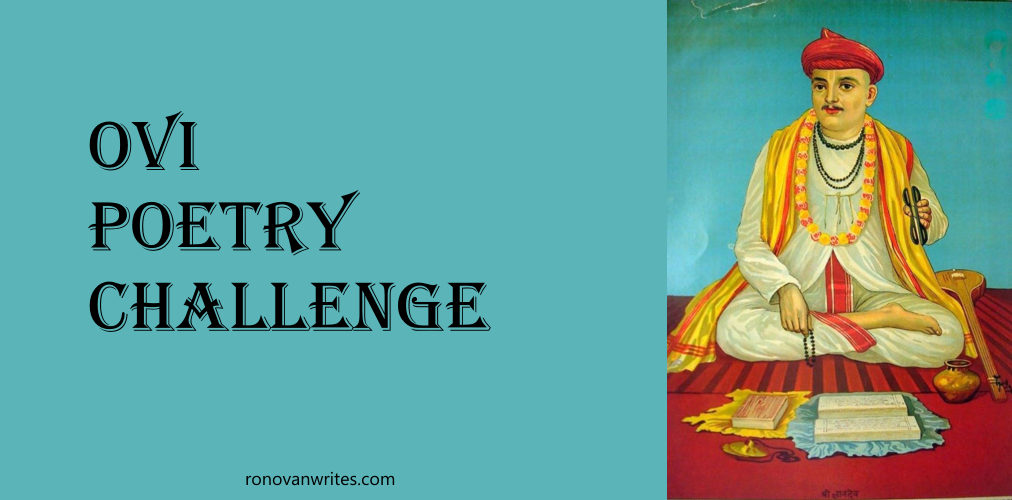
Ovi Poetry Challenge 11: TASTE is your inspiration.

What’s your TASTE? Is good, bad, unsavory? Am I talking about flavors or opinions?

First, remember, YOU DON’T HAVE TO USE THE WORD of the CHALLENGE in your poem, but use it if you like.


OVI POETRY

Ovi is a syllabic/metre poetry form. In this case, Ovi is from India, originating in the Marathi language. The Ovi  has been in use in written form since the 13th Century, but the women’s ovee/ovi predates the literary form by at least the 12th Century.

The Ovi are in general, lyrical folk songs expressing love, social irony, and heroic events. They are written in the following scheme.

4 line stanzas, as few as one stanza and up to as many as you like.

8 syllables or less per line

Rhyming is AAAb. The second stanza would be CCCd. The third, EEEf. And so on. Meaning nothing in one stanza must rhyme with anything in the previous stanza. The fourth line does not rhyme.

Example:

Roly Poly by Judi Van Gorder

The big toothed tot with golden hair
picked up a bug on Sister’s dare,
it rolled into a ball right there
and won her springtime heart.

Notice the rhyming pattern is AAAb or
A
A
A
b

My Attempt

Blue flowers continue to grow,
with the shadow’s making them glow,
giving life to darkness and woe,
dying each year to yet return.

Enter your email address to subscribe to this blog and receive notifications of new posts by email.

Ovi Poetry Challenge 10: JUSTICE is your inspiration.

In the United States right now we have some crazy things happening with our political system. Justice, revenge? Both. Politics? Definitely.

First, remember, YOU DON’T HAVE TO USE THE WORD of the CHALLENGE in your poem, but use it if you like.


OVI POETRY

Ovi is a syllabic/metre poetry form. In this case, Ovi is from India, originating in the Marathi language. The Ovi  has been in use in written form since the 13th Century, but the women’s ovee/ovi predates the literary form by at least the 12th Century.

The Ovi are in general, lyrical folk songs expressing love, social irony, and heroic events. They are written in the following scheme.

4 line stanzas, as few as one stanza and up to as many as you like.

8 syllables or less per line

Rhyming is AAAb. The second stanza would be CCCd. The third, EEEf. And so on. Meaning nothing in one stanza must rhyme with anything in the previous stanza. The fourth line does not rhyme.

Example:

Roly Poly by Judi Van Gorder

The big toothed tot with golden hair
picked up a bug on Sister’s dare,
it rolled into a ball right there
and won her springtime heart.

Notice the rhyming pattern is AAAb or
A
A
A
b

My Attempt

Blue flowers continue to grow,
with the shadow’s making them glow,
giving life to darkness and woe,
dying each year to yet return.

Enter your email address to subscribe to this blog and receive notifications of new posts by email.

Ovi Poetry Challenge 9: RIGHT is your inspiration.

First, remember, YOU DON’T HAVE TO USE THE WORD of the CHALLENGE in your poem, but use it if you like.


OVI POETRY

Ovi is a syllabic/metre poetry form. In this case, Ovi is from India, originating in the Marathi language. The Ovi  has been in use in written form since the 13th Century, but the women’s ovee/ovi predates the literary form by at least the 12th Century.

The Ovi are in general, lyrical folk songs expressing love, social irony, and heroic events. They are written in the following scheme.

4 line stanzas, as few as one stanza and up to as many as you like.

8 syllables or less per line

Rhyming is AAAb. The second stanza would be CCCd. The third, EEEf. And so on. Meaning nothing in one stanza must rhyme with anything in the previous stanza. The fourth line does not rhyme.

Example:

Roly Poly by Judi Van Gorder

The big toothed tot with golden hair
picked up a bug on Sister’s dare,
it rolled into a ball right there
and won her springtime heart.

Notice the rhyming pattern is AAAb or
A
A
A
b

My Attempt

Blue flowers continue to grow,
with the shadow’s making them glow,
giving life to darkness and woe,
dying each year to yet return.

Enter your email address to subscribe to this blog and receive notifications of new posts by email.

Ovi Poetry Challenge 8: CHOICE is your inspiration.

Do we really have choices?

First, remember, YOU DON’T HAVE TO USE THE WORD of the CHALLENGE in your poem, but use it if you like.


OVI POETRY

Ovi is a syllabic/metre poetry form. In this case, Ovi is from India, originating in the Marathi language. The Ovi  has been in use in written form since the 13th Century, but the women’s ovee/ovi predates the literary form by at least the 12th Century.

The Ovi are in general, lyrical folk songs expressing love, social irony, and heroic events. They are written in the following scheme.

4 line stanzas, as few as one stanza and up to as many as you like.

8 syllables or less per line

Rhyming is AAAb. The second stanza would be CCCd. The third, EEEf. And so on. Meaning nothing in one stanza must rhyme with anything in the previous stanza. The fourth line does not rhyme.

Example:

Roly Poly by Judi Van Gorder

The big toothed tot with golden hair
picked up a bug on Sister’s dare,
it rolled into a ball right there
and won her springtime heart.

Notice the rhyming pattern is AAAb or
A
A
A
b

My Attempt

Blue flowers continue to grow,
with the shadow’s making them glow,
giving life to darkness and woe,
dying each year to yet return.

Enter your email address to subscribe to this blog and receive notifications of new posts by email.

Ovi Poetry Challenge 7: Play is your inspiration.

In addition to the obvious use of the word, I’m inclined toward what type of Play Shakespeare would write about the world today. I have the title, but the old Bard would need to make a comeback in order to write it.

First, remember, YOU DON’T HAVE TO USE THE WORD of the CHALLENGE in your poem, but use it if you like.


OVI POETRY

Ovi is a syllabic/metre poetry form. In this case, Ovi is from India, originating in the Marathi language. The Ovi  has been in use in written form since the 13th Century, but the women’s ovee/ovi predates the literary form by at least the 12th Century.

The Ovi are in general, lyrical folk songs expressing love, social irony, and heroic events. They are written in the following scheme.

4 line stanzas, as few as one stanza and up to as many as you like.

8 syllables or less per line

Rhyming is AAAb. The second stanza would be CCCd. The third, EEEf. And so on. Meaning nothing in one stanza must rhyme with anything in the previous stanza. The fourth line does not rhyme.

Example:

Roly Poly by Judi Van Gorder

The big toothed tot with golden hair
picked up a bug on Sister’s dare,
it rolled into a ball right there
and won her springtime heart.

Notice the rhyming pattern is AAAb or
A
A
A
b

My Attempt

Blue flowers continue to grow,
with the shadow’s making them glow,
giving life to darkness and woe,
dying each year to yet return.

Enter your email address to subscribe to this blog and receive notifications of new posts by email.

Ovi Poetry Challenge 6: GOOD is your inspiration.

First, remember, YOU DON’T HAVE TO USE THE WORD of the CHALLENGE in your poem, but use it if you like.


OVI POETRY

Ovi is a syllabic/metre poetry form. In this case, Ovi is from India, originating in the Marathi language. The Ovi  has been in use in written form since the 13th Century, but the women’s ovee/ovi predates the literary form by at least the 12th Century.

The Ovi are in general, lyrical folk songs expressing love, social irony, and heroic events. They are written in the following scheme.

4 line stanzas, as few as one stanza and up to as many as you like.

8 syllables or less per line

Rhyming is AAAb. The second stanza would be CCCd. The third, EEEf. And so on. Meaning nothing in one stanza must rhyme with anything in the previous stanza. The fourth line does not rhyme.

Example:

Roly Poly by Judi Van Gorder

The big toothed tot with golden hair
picked up a bug on Sister’s dare,
it rolled into a ball right there
and won her springtime heart.

Notice the rhyming pattern is AAAb or
A
A
A
b

My Attempt

Blue flowers continue to grow,
with the shadow’s making them glow,
giving life to darkness and woe,
dying each year to yet return.

Enter your email address to subscribe to this blog and receive notifications of new posts by email.

Ovi Poetry Challenge 5: EQUAL is your inspiration.

First, remember, YOU DON’T HAVE TO USE THE WORD of the CHALLENGE in your poem, but use it if you like.


OVI POETRY

Ovi is a syllabic/metre poetry form. In this case, Ovi is from India, originating in the Marathi language. The Ovi  has been in use in written form since the 13th Century, but the women’s ovee/ovi predates the literary form by at least the 12th Century.

The Ovi are in general, lyrical folk songs expressing love, social irony, and heroic events. They are written in the following scheme.

4 line stanzas, as few as one stanza and up to as many as you like.

8 syllables or less per line

Rhyming is AAAb. The second stanza would be CCCd. The third, EEEf. And so on. Meaning nothing in one stanza must rhyme with anything in the previous stanza. The fourth line does not rhyme.

Example:

Roly Poly by Judi Van Gorder

The big toothed tot with golden hair
picked up a bug on Sister’s dare,
it rolled into a ball right there
and won her springtime heart.

Notice the rhyming pattern is AAAb or
A
A
A
b

My Attempt

Blue flowers continue to grow,
with the shadow’s making them glow,
giving life to darkness and woe,
dying each year to yet return.

Enter your email address to subscribe to this blog and receive notifications of new posts by email.

Ovi Poetry Challenge 4: RACE is your inspiration.

First, remember, YOU DON’T HAVE TO USE THE WORD of the CHALLENGE in your poem, but use it if you like.


OVI POETRY

Ovi is a syllabic/metre poetry form. In this case, Ovi is from India, originating in the Marathi language. The Ovi  has been in use in written form since the 13th Century, but the women’s ovee/ovi predates the literary form by at least the 12th Century.

The Ovi are in general, lyrical folk songs expressing love, social irony, and heroic events. They are written in the following scheme.

4 line stanzas, as few as one stanza and up to as many as you like.

8 syllables or less per line

Rhyming is AAAb. The second stanza would be CCCd. The third, EEEf. And so on. Meaning nothing in one stanza must rhyme with anything in the previous stanza. The fourth line does not rhyme.

Example:

Roly Poly by Judi Van Gorder

The big toothed tot with golden hair
picked up a bug on Sister’s dare,
it rolled into a ball right there
and won her springtime heart.

Notice the rhyming pattern is AAAb or
A
A
A
b

My Attempt

Blue flowers continue to grow,
with the shadow’s making them glow,
giving life to darkness and woe,
dying each year to yet return.

Enter your email address to subscribe to this blog and receive notifications of new posts by email.

Ovi Poetry Challenge 3: INDEPENDENCE is your inspiration.

First, remember, YOU DON’T HAVE TO USE THE WORDS of the CHALLENGE. They are the inspiration

So it’s a day later than July 4th but still, that’s the inspiration for this one. And boy does INDEPENDENCE have many interpretations.


OVI POETRY

Ovi is a syllabic/metre poetry form. In this case, Ovi is from India, originating in the Marathi language. The Ovi  has been in use in written form since the 13th Century, but the women’s ovee/ovi predates the literary form by at least the 12th Century.

The Ovi are in general, lyrical folk songs expressing love, social irony, and heroic events. They are written in the following scheme.

4 line stanzas, as few as one stanza and up to as many as you like.

8 syllables or less per line

Rhyming is AAAb. The second stanza would be CCCd. The third, EEEf. And so on. Meaning nothing in one stanza must rhyme with anything in the previous stanza. The fourth line does not rhyme.

Example:

Roly Poly by Judi Van Gorder

The big toothed tot with golden hair
picked up a bug on Sister’s dare,
it rolled into a ball right there
and won her springtime heart.

Notice the rhyming pattern is AAAb or
A
A
A
b

My Attempt

Blue flowers continue to grow,
with the shadow’s making them glow,
giving life to darkness and woe,
dying each year to yet return.

Enter your email address to subscribe to this blog and receive notifications of new posts by email.

Ovi Poetry Challenge 2: HEART is your inspiration.

First, remember, YOU DON’T HAVE TO USE THE WORDS of the CHALLENGE. They are the inspiration


OVI POETRY

Ovi is a syllabic/metre poetry form. In this case, Ovi is from India, originating in the Marathi language. The Ovi  has been in use in written form since the 13th Century, but the women’s ovee/ovi predates the literary form by at least the 12th Century.

The Ovi are in general, lyrical folk songs expressing love, social irony, and heroic events. They are written in the following scheme.

4 line stanzas, as few as one stanza and up to as many as you like.

8 syllables or less per line

Rhyming is AAAb. The second stanza would be CCCd. The third, EEEf. And so on. Meaning nothing in one stanza must rhyme with anything in the previous stanza. The fourth line does not rhyme.

Example:

Roly Poly by Judi Van Gorder

The big toothed tot with golden hair
picked up a bug on Sister’s dare,
it rolled into a ball right there
and won her springtime heart.

Notice the rhyming pattern is AAAb or
A
A
A
b

My Attempt

Blue flowers continue to grow,
with the shadow’s making them glow,
giving life to darkness and woe,
dying each year to yet return.

Enter your email address to subscribe to this blog and receive notifications of new posts by email.

Ovi Poetry Challenge: ROLE MODEL is your inspiration.

FIrst, remember, YOU DON’T HAVE TO USE THE WORDS of the CHALLENGE. They are the inspiration

Again, this week, SOCIAL IRONY is my go to. Which makes you think about LOVE at the same time. Yeah, I know. I’m two minds about things. It’s the Gemini in me.

OVI POETRY

Ovi is a syllabic/metre poetry form. In this case, Ovi is from India, originating in the Marathi language. The Ovi  has been in use in written form since the 13th Century, but the women’s ovee/ovi predates the literary form by at least the 12th Century.

The Ovi are in general, lyrical folk songs expressing love, social irony, and heroic events. They are written in the following scheme.

4 line stanzas, as few as one stanza and up to as many as you like.

8 syllables or less per line

Rhyming is AAAb. The second stanza would be CCCd. The third, EEEf. And so on. Meaning nothing in one stanza must rhyme with anything in the previous stanza. The fourth line does not rhyme.

Example:

Roly Poly by Judi Van Gorder

The big toothed tot with golden hair
picked up a bug on Sister’s dare,
it rolled into a ball right there
and won her springtime heart.

Notice the rhyming pattern is AAAb or
A
A
A
b

My Attempt

Blue flowers continue to grow,
with the shadow’s making them glow,
giving life to darkness and woe,
dying each year to yet return.


Enter your email address to subscribe to this blog and receive notifications of new posts by email.

Ovi Poetry Challenge: FREEDOM is your inspiration.

Thinking about FREEDOM, my first consideration was the SOCIAL IRONY theme of OVI POETRY. But, there are several other ways to go. LOVE is definitely one, as in the freedom to love or the freedom of being rid of a love gone bad. HEROIC FREEDOM is probably the most obvious. But there is also a freedom of spirit, mind, from stress.

OVI POETRY

Ovi is a syllabic/metre poetry form. In this case, Ovi is from India, originating in the Marathi language. The Ovi  has been in use in written form since the 13th Century, but the women’s ovee/ovi predates the literary form by at least the 12th Century.

The Ovi are in general, lyrical folk songs expressing love, social irony, and heroic events. They are written in the following scheme.

4 line stanzas, as few as one stanza and up to as many as you like.

8 syllables or less per line

Rhyming is AAAb. The second stanza would be CCCd. The third, EEEf. And so on. Meaning nothing in one stanza must rhyme with anything in the previous stanza. The fourth line does not rhyme.

Example:

Roly Poly by Judi Van Gorder

The big toothed tot with golden hair
picked up a bug on Sister’s dare,
it rolled into a ball right there
and won her springtime heart.

Notice the rhyming pattern is AAAb or
A
A
A
b

My Attempt

Blue flowers continue to grow,
with the shadow’s making them glow,
giving life to darkness and woe,
dying each year to yet return.


Enter your email address to subscribe to this blog and receive notifications of new posts by email.

Ovi Poetry Practice Challenge: Valley.

The Sijo Prompt Challenge has come to an end for now. It’s difficult to come up with good prompt subjects and rather than try to make it to 100 and give mediocre ideas, we’re moving onto another form of poetry. And I didn’t really do it with it what I wanted to. So here we are, a new poetry form to learn about and try.

OVI POETRY

As is the case with this blog’s prompt poems, Ovi is a syllabic/metre poetry form. In this case, Ovi is from India, originating in the Marathi language. The Ovi  has been in use in written form since the 13th Century, but the women’s ovee/ovi predates the literary form by at least the 12th Century.

The Ovi are in general, lyrical folk songs expressing love, social irony, and heroic events. They are written in the following scheme.

4 line stanzas, as few as one stanza and up to as many as you like.

8 syllables or less per line

Rhyming is AAAb. The second stanza would be CCCd. The third, EEEf. And so on. Meaning nothing in one stanza must rhyme with anything in the previous stanza. The fourth line does not rhyme.

Example:

Roly Poly by Judi Van Gorder

The big toothed tot with golden hair
picked up a bug on Sister’s dare,
it rolled into a ball right there
and won her springtime heart.

Notice the rhyming pattern is AAAb or
A
A
A
b

My Attempt

Blue flowers continue to grow,
with the shadow’s making them glow,
giving life to darkness and woe,
dying each year to yet return.

Enter your email address to subscribe to this blog and receive notifications of new posts by email.

Ronovan Writes SIJO Wednesday Poetry Challenge #64. Use COMPLETION as your inspiration this week.

“You don’t know reality until someone makes fiction of it. Reality needs the completion of fiction.” Tony Wilson


Thesaurus.com

Merriam-Webster.com

Use the above links to discover the various interpretations of the word of the week. Don’t limit yourself to the first one that comes to mind. Expand your thinking.


A new form of poetry for us to try. Yes, the Décima Challenge has come to an end after 100 weeks.

Now we have the Sijo, a Korean form believed to have first been used in the fourteenth century. It is similar in structure to various Japanese forms such as Haiku. As with many forms of poetry, the Sijo became a preferred poetry form of the yangban or ruling class as well as royalty. They were written in Chinese and were originally short songs set to music. The focus of the Sijo is usually nature and contemplation. We’ll try that to begin with.

You should use the word in the title of this post as your inspiration as either a theme of the Sijo or in the poem itself.

There are:

  • Three Lines
  • 14-16 syllables per line
  • A total of 44-46 syllables for the entire poem.

To know how many syllables in a particular word try HowManySyllables.com.

  • The first line of the Sijo usually sets the theme.
  • The second line elaborates on the first line.
  • The third line brings the poem matter to a close.

The setting can be nature, a favorite season, or some event of your day. Something, as I mentioned above that can be contemplative in nature.

Within each of the three lines there is usually a pause. You can hear it in the example below. The bold sections are the parts after the pause, or at least as I read/hear them. Reading your Sijo out loud will help with using the correct form.

The following example is considered the oldest Sijo in existence,

The spring breeze melted snow on the hills then quickly disappeared.
I wish I could borrow it briefly to blow over my hair
And melt away the aging frost forming now about my ears.

If I’m counting right there are 15 syllables per line. I think that would be a good target but the pattern is up to you, as per the generally held thoughts on the matter.


As with all of the challenges that have been hosted here be sure to;

  1. Copy and past your URL into the comments below so other poets can visit and read your
  2. You can also put the link of this challenge in your post to let your followers know where to go if they want to participate. This is called a Pingback. This is not mandatory to join in or to put your post link in the comments. Click HERE to find out how to do a Pingback.
  3. Reblogging is great as well.

Enter your email address to subscribe to this blog and receive notifications of new posts by email.

Ronovan Writes Sijo Challenge Image

Enter your email address to subscribe to this blog and receive notifications of new posts by email.

Ronovan Writes SIJO Wednesday Poetry Challenge #63. Use PET as your inspiration this week.

“He who is cruel to animals becomes hard also in his dealings with men. We can judge the heart of a man by his treatment of animals.” Immanuel Kant


Thesaurus.com

Merriam-Webster.com

Use the above links to discover the various interpretations of the word of the week. Don’t limit yourself to the first one that comes to mind. Expand your thinking.


A new form of poetry for us to try. Yes, the Décima Challenge has come to an end after 100 weeks.

Now we have the Sijo, a Korean form believed to have first been used in the fourteenth century. It is similar in structure to various Japanese forms such as Haiku. As with many forms of poetry, the Sijo became a preferred poetry form of the yangban or ruling class as well as royalty. They were written in Chinese and were originally short songs set to music. The focus of the Sijo is usually nature and contemplation. We’ll try that to begin with.

You should use the word in the title of this post as your inspiration as either a theme of the Sijo or in the poem itself.

There are:

  • Three Lines
  • 14-16 syllables per line
  • A total of 44-46 syllables for the entire poem.

To know how many syllables in a particular word try HowManySyllables.com.

  • The first line of the Sijo usually sets the theme.
  • The second line elaborates on the first line.
  • The third line brings the poem matter to a close.

The setting can be nature, a favorite season, or some event of your day. Something, as I mentioned above that can be contemplative in nature.

Within each of the three lines there is usually a pause. You can hear it in the example below. The bold sections are the parts after the pause, or at least as I read/hear them. Reading your Sijo out loud will help with using the correct form.

The following example is considered the oldest Sijo in existence,

The spring breeze melted snow on the hills then quickly disappeared.
I wish I could borrow it briefly to blow over my hair
And melt away the aging frost forming now about my ears.

If I’m counting right there are 15 syllables per line. I think that would be a good target but the pattern is up to you, as per the generally held thoughts on the matter.


As with all of the challenges that have been hosted here be sure to;

  1. Copy and past your URL into the comments below so other poets can visit and read your
  2. You can also put the link of this challenge in your post to let your followers know where to go if they want to participate. This is called a Pingback. This is not mandatory to join in or to put your post link in the comments. Click HERE to find out how to do a Pingback.
  3. Reblogging is great as well.

Enter your email address to subscribe to this blog and receive notifications of new posts by email.

Ronovan Writes Sijo Challenge Image

Enter your email address to subscribe to this blog and receive notifications of new posts by email.

Ronovan Writes SIJO Wednesday Poetry Challenge #62. Use ART as your inspiration this week.

“If art is to nourish the roots of our culture, society must set the artist free to follow his vision wherever it takes him.” John F. Kennedy


Thesaurus.com

Merriam-Webster.com

Use the above links to discover the various interpretations of the word of the week. Don’t limit yourself to the first one that comes to mind. Expand your thinking.


A new form of poetry for us to try. Yes, the Décima Challenge has come to an end after 100 weeks.

Now we have the Sijo, a Korean form believed to have first been used in the fourteenth century. It is similar in structure to various Japanese forms such as Haiku. As with many forms of poetry, the Sijo became a preferred poetry form of the yangban or ruling class as well as royalty. They were written in Chinese and were originally short songs set to music. The focus of the Sijo is usually nature and contemplation. We’ll try that to begin with.

You should use the word in the title of this post as your inspiration as either a theme of the Sijo or in the poem itself.

There are:

  • Three Lines
  • 14-16 syllables per line
  • A total of 44-46 syllables for the entire poem.

To know how many syllables in a particular word try HowManySyllables.com.

  • The first line of the Sijo usually sets the theme.
  • The second line elaborates on the first line.
  • The third line brings the poem matter to a close.

The setting can be nature, a favorite season, or some event of your day. Something, as I mentioned above that can be contemplative in nature.

Within each of the three lines there is usually a pause. You can hear it in the example below. The bold sections are the parts after the pause, or at least as I read/hear them. Reading your Sijo out loud will help with using the correct form.

The following example is considered the oldest Sijo in existence,

The spring breeze melted snow on the hills then quickly disappeared.
I wish I could borrow it briefly to blow over my hair
And melt away the aging frost forming now about my ears.

If I’m counting right there are 15 syllables per line. I think that would be a good target but the pattern is up to you, as per the generally held thoughts on the matter.


As with all of the challenges that have been hosted here be sure to;

  1. Copy and past your URL into the comments below so other poets can visit and read your
  2. You can also put the link of this challenge in your post to let your followers know where to go if they want to participate. This is called a Pingback. This is not mandatory to join in or to put your post link in the comments. Click HERE to find out how to do a Pingback.
  3. Reblogging is great as well.

Enter your email address to subscribe to this blog and receive notifications of new posts by email.

Ronovan Writes Sijo Challenge Image

Enter your email address to subscribe to this blog and receive notifications of new posts by email.

Ronovan Writes SIJO Wednesday Poetry Challenge #61. Use FOOD as your inspiration this week.

“One cannot think well, love well, sleep well, if one has not dined well.” Virginia Woolf


Thesaurus.com

Merriam-Webster.com

Use the above links to discover the various interpretations of the word of the week. Don’t limit yourself to the first one that comes to mind. Expand your thinking.


A new form of poetry for us to try. Yes, the Décima Challenge has come to an end after 100 weeks.

Now we have the Sijo, a Korean form believed to have first been used in the fourteenth century. It is similar in structure to various Japanese forms such as Haiku. As with many forms of poetry, the Sijo became a preferred poetry form of the yangban or ruling class as well as royalty. They were written in Chinese and were originally short songs set to music. The focus of the Sijo is usually nature and contemplation. We’ll try that to begin with.

You should use the word in the title of this post as your inspiration as either a theme of the Sijo or in the poem itself.

There are:

  • Three Lines
  • 14-16 syllables per line
  • A total of 44-46 syllables for the entire poem.

To know how many syllables in a particular word try HowManySyllables.com.

  • The first line of the Sijo usually sets the theme.
  • The second line elaborates on the first line.
  • The third line brings the poem matter to a close.

The setting can be nature, a favorite season, or some event of your day. Something, as I mentioned above that can be contemplative in nature.

Within each of the three lines there is usually a pause. You can hear it in the example below. The bold sections are the parts after the pause, or at least as I read/hear them. Reading your Sijo out loud will help with using the correct form.

The following example is considered the oldest Sijo in existence,

The spring breeze melted snow on the hills then quickly disappeared.
I wish I could borrow it briefly to blow over my hair
And melt away the aging frost forming now about my ears.

If I’m counting right there are 15 syllables per line. I think that would be a good target but the pattern is up to you, as per the generally held thoughts on the matter.


As with all of the challenges that have been hosted here be sure to;

  1. Copy and past your URL into the comments below so other poets can visit and read your
  2. You can also put the link of this challenge in your post to let your followers know where to go if they want to participate. This is called a Pingback. This is not mandatory to join in or to put your post link in the comments. Click HERE to find out how to do a Pingback.
  3. Reblogging is great as well.

Enter your email address to subscribe to this blog and receive notifications of new posts by email.

Ronovan Writes Sijo Challenge Image

Enter your email address to subscribe to this blog and receive notifications of new posts by email.

Ronovan Writes SIJO Wednesday Poetry Challenge #60. Use EMOTION as your inspiration this week.

Sometimes you don’t need a quote.


Thesaurus.com

Merriam-Webster.com

Use the above links to discover the various interpretations of the word of the week. Don’t limit yourself to the first one that comes to mind. Expand your thinking.


A new form of poetry for us to try. Yes, the Décima Challenge has come to an end after 100 weeks.

Now we have the Sijo, a Korean form believed to have first been used in the fourteenth century. It is similar in structure to various Japanese forms such as Haiku. As with many forms of poetry, the Sijo became a preferred poetry form of the yangban or ruling class as well as royalty. They were written in Chinese and were originally short songs set to music. The focus of the Sijo is usually nature and contemplation. We’ll try that to begin with.

You should use the word in the title of this post as your inspiration as either a theme of the Sijo or in the poem itself.

There are:

  • Three Lines
  • 14-16 syllables per line
  • A total of 44-46 syllables for the entire poem.

To know how many syllables in a particular word try HowManySyllables.com.

  • The first line of the Sijo usually sets the theme.
  • The second line elaborates on the first line.
  • The third line brings the poem matter to a close.

The setting can be nature, a favorite season, or some event of your day. Something, as I mentioned above that can be contemplative in nature.

Within each of the three lines there is usually a pause. You can hear it in the example below. The bold sections are the parts after the pause, or at least as I read/hear them. Reading your Sijo out loud will help with using the correct form.

The following example is considered the oldest Sijo in existence,

The spring breeze melted snow on the hills then quickly disappeared.
I wish I could borrow it briefly to blow over my hair
And melt away the aging frost forming now about my ears.

If I’m counting right there are 15 syllables per line. I think that would be a good target but the pattern is up to you, as per the generally held thoughts on the matter.


As with all of the challenges that have been hosted here be sure to;

  1. Copy and past your URL into the comments below so other poets can visit and read your
  2. You can also put the link of this challenge in your post to let your followers know where to go if they want to participate. This is called a Pingback. This is not mandatory to join in or to put your post link in the comments. Click HERE to find out how to do a Pingback.
  3. Reblogging is great as well.

Enter your email address to subscribe to this blog and receive notifications of new posts by email.

Ronovan Writes Sijo Challenge Image

Enter your email address to subscribe to this blog and receive notifications of new posts by email.

Ronovan Writes SIJO Wednesday Poetry Challenge #59. Use FAMILY as your inspiration this week.

“The family you come from isn’t as important as the family you’re going to have.” Ring Lardner

And what family do you consider to be the one you have? Is that made up of the biological or those you come to love as if they were biological? And are you allowed to disassociate yourself from the biological if they are of the way you don’t want to be a part of?

Family becomes an interesting word once you begin to break it down. Not the family, but the idea of what makes up a family. (Me just getting thinky lately.)

Thesaurus.com

Merriam-Webster.com

Use the above links to discover the various interpretations of the word of the week. Don’t limit yourself to the first one that comes to mind. Expand your thinking.


A new form of poetry for us to try. Yes, the Décima Challenge has come to an end after 100 weeks.

Now we have the Sijo, a Korean form believed to have first been used in the fourteenth century. It is similar in structure to various Japanese forms such as Haiku. As with many forms of poetry, the Sijo became a preferred poetry form of the yangban or ruling class as well as royalty. They were written in Chinese and were originally short songs set to music. The focus of the Sijo is usually nature and contemplation. We’ll try that to begin with.

You should use the word in the title of this post as your inspiration as either a theme of the Sijo or in the poem itself.

There are:

  • Three Lines
  • 14-16 syllables per line
  • A total of 44-46 syllables for the entire poem.

To know how many syllables in a particular word try HowManySyllables.com.

  • The first line of the Sijo usually sets the theme.
  • The second line elaborates on the first line.
  • The third line brings the poem matter to a close.

The setting can be nature, a favorite season, or some event of your day. Something, as I mentioned above that can be contemplative in nature.

Within each of the three lines there is usually a pause. You can hear it in the example below. The bold sections are the parts after the pause, or at least as I read/hear them. Reading your Sijo out loud will help with using the correct form.

The following example is considered the oldest Sijo in existence,

The spring breeze melted snow on the hills then quickly disappeared.
I wish I could borrow it briefly to blow over my hair
And melt away the aging frost forming now about my ears.

If I’m counting right there are 15 syllables per line. I think that would be a good target but the pattern is up to you, as per the generally held thoughts on the matter.


As with all of the challenges that have been hosted here be sure to;

  1. Copy and past your URL into the comments below so other poets can visit and read your
  2. You can also put the link of this challenge in your post to let your followers know where to go if they want to participate. This is called a Pingback. This is not mandatory to join in or to put your post link in the comments. Click HERE to find out how to do a Pingback.
  3. Reblogging is great as well.

Enter your email address to subscribe to this blog and receive notifications of new posts by email.

Ronovan Writes Sijo Challenge Image

Enter your email address to subscribe to this blog and receive notifications of new posts by email.

Ronovan Writes SIJO Wednesday Poetry Challenge #58. Use PLEASE as your inspiration this week.

“I never desired to please the rabble. What pleased them, I did not learn; and what I knew was far removed from their understanding.” Epicurus


Thesaurus.com

Merriam-Webster.com

Use the above links to discover the various interpretations of the word of the week. Don’t limit yourself to the first one that comes to mind. Expand your thinking.


A new form of poetry for us to try. Yes, the Décima Challenge has come to an end after 100 weeks.

Now we have the Sijo, a Korean form believed to have first been used in the fourteenth century. It is similar in structure to various Japanese forms such as Haiku. As with many forms of poetry, the Sijo became a preferred poetry form of the yangban or ruling class as well as royalty. They were written in Chinese and were originally short songs set to music. The focus of the Sijo is usually nature and contemplation. We’ll try that to begin with.

You should use the word in the title of this post as your inspiration as either a theme of the Sijo or in the poem itself.

There are:

  • Three Lines
  • 14-16 syllables per line
  • A total of 44-46 syllables for the entire poem.

To know how many syllables in a particular word try HowManySyllables.com.

  • The first line of the Sijo usually sets the theme.
  • The second line elaborates on the first line.
  • The third line brings the poem matter to a close.

The setting can be nature, a favorite season, or some event of your day. Something, as I mentioned above that can be contemplative in nature.

Within each of the three lines there is usually a pause. You can hear it in the example below. The bold sections are the parts after the pause, or at least as I read/hear them. Reading your Sijo out loud will help with using the correct form.

The following example is considered the oldest Sijo in existence,

The spring breeze melted snow on the hills then quickly disappeared.
I wish I could borrow it briefly to blow over my hair
And melt away the aging frost forming now about my ears.

If I’m counting right there are 15 syllables per line. I think that would be a good target but the pattern is up to you, as per the generally held thoughts on the matter.


As with all of the challenges that have been hosted here be sure to;

  1. Copy and past your URL into the comments below so other poets can visit and read your
  2. You can also put the link of this challenge in your post to let your followers know where to go if they want to participate. This is called a Pingback. This is not mandatory to join in or to put your post link in the comments. Click HERE to find out how to do a Pingback.
  3. Reblogging is great as well.

Enter your email address to subscribe to this blog and receive notifications of new posts by email.

Ronovan Writes Sijo Challenge Image

Enter your email address to subscribe to this blog and receive notifications of new posts by email.