Cinquain Poetry Prompt 16: BELIEVE is your inspiration.

You don’t have to use the word in your poem, you can just use it as inspiration.

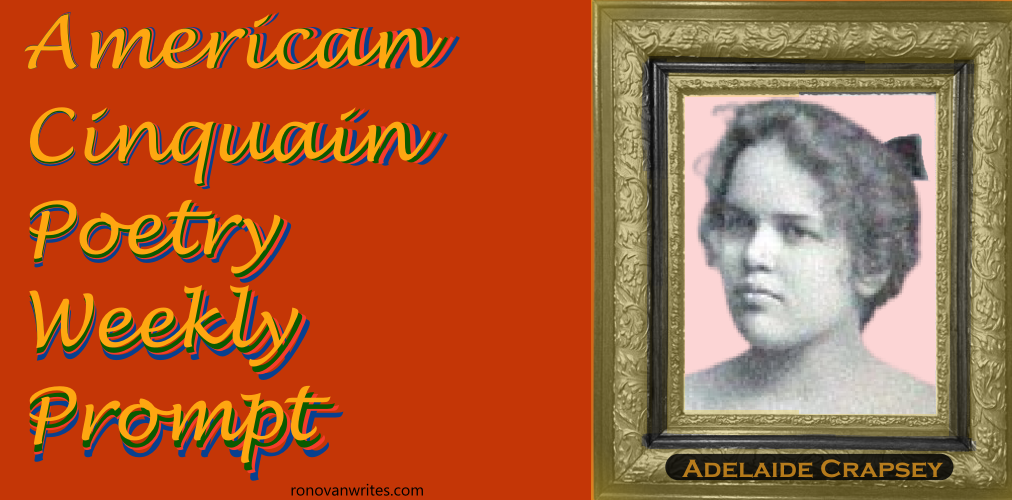
The Amerian Cinquain style is named as such because of it’s creator, the American poet  Adelaide Crapsey. Learn about Adelaide and her short but productive life here. Creative, brilliant, and tragedy.

Yes, there is kind of a way of the madness of the poetry form, but you really just use the structure to create what you want in order to get your message across. There are examples of Adelaide Crapsey’s work below.

The Cinquain or more specifically the American Cinquain.

My Example:

Old Days

See how
The sun rises,
Breaking over beauty,
Filling the senses with heaven
Then fades.

You can see the pattern above is as follows…

THE STRUCTURE

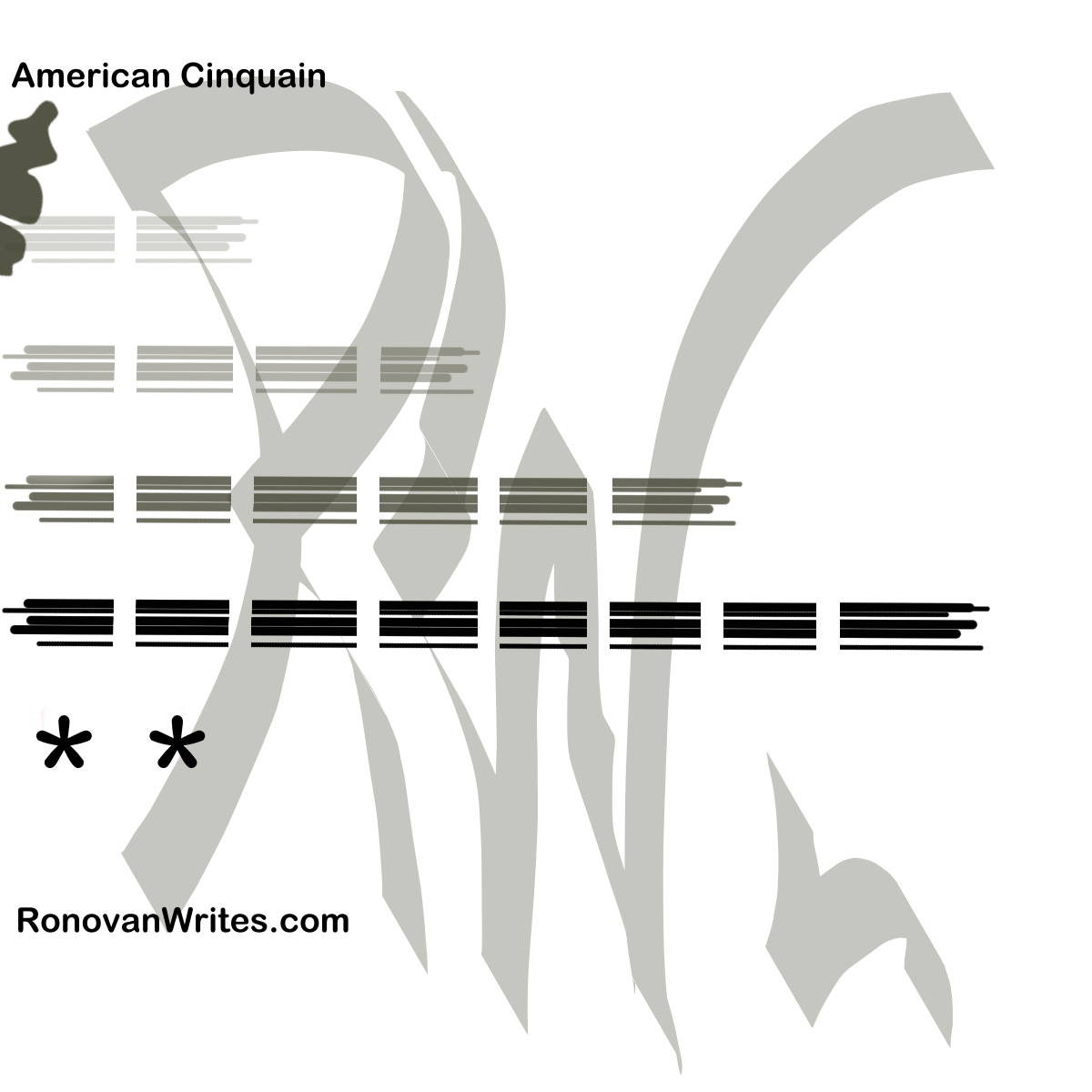
5 Lines with each a given number of syllables as

2
4
6
8
2

An iambic foot with the stresses by line being

1
2
3
4
1

For the first line of the poem there will be two syllables with one stressed syllable and that one being the second one, which establishes the pattern.

The Cinquain most commonly used is the American Cinquain created by Adelaide Crapsey. Although she did not write down specific rules for composing one of her Cinquains, we have a form from people who have studied her poetry and have found commonalities in her works, those being the syllable and iambic foot, stresses pattern, although the iambic foot is not a requirement. Think of iambic foot and meter as the beat of music and the poem. Every other syllable is the beat.

THE CONTENT

As much as structure dictates an American Cinquain, the content and descriptive nature of the poem is just as important. Emotion. Nature. Event. Idea. All of those can be what brings words to the poem. If you’re not accustomed to cinquain yet, or your idea of a poem is big, write your poem as long as it needs to be to get your story down. Then you start zeroing in on structure. Then you turn that original idea and those original words into such concise and descriptive wording that in just 22 syllables you tell your story.

As you tell the story, remember that often, and usually, the last line flips the story you’ve told. A negative poem ends with a positive, a positive with a negative. A story of anger ends in peace. Oppressed ends in freedom.

Using my example, I tell a story of could be an actual sunrise, emotions, or an event. It’s a pleasant and serene, inspiring tale, then with the ending it all disappears. Yes, a sunrise disappears, an event ends, the joyful emotions of love may end in total darkness and depression.

Two Adelaide Crapsey Cinquain poems:

November Night

Listen . . .
With faint dry sound,
Like steps of passing ghosts,
The leaves, frost-crisp’d, break from the trees
And fall.

Trapped

Well and
If day on day
Follows and weary year
On year . . . and ever days and years . . .
Well?

LINKING BACK TO THE PROMPT:

One way to increase interest in prompt challenges is to link back or pingback to the prompt when you write your response on your blog. This can also have a couple or more extra visits to your post.

Click HERE to find out how to do a Pingback. It’s a post I created a long time ago. It includes an image showing you how to do it.

Some people like to copy and paste the challenge image into their posts. That’s okay with me.
American Cinquain Poetry Prompt

Enter your email address to subscribe to this blog and receive notifications of new posts by email.

© 2025- Ronovan Hester Copyright reserved. The author asserts his moral and legal rights over this work.
Whatever – a Cinquain.

Whatever

Monday.

Goals, plans, and dreams.

Working through the problems,

breaking down barriers. Success!

Yeah, right.


American Cinquain Ronovan Writes image

For this weeks Cinquain Poetry Prompt of THRIVE.

Enter your email address to subscribe to this blog and receive notifications of new posts by email.

© 2025- Ronovan Hester Copyright reserved. The author asserts his moral and legal rights over this work.

Cinquain Poetry Prompt 15: THRIVE is your inspiration.

You don’t have to use the word in your poem, you can just use it as inspiration.

The Amerian Cinquain style is named as such because of it’s creator, the American poet  Adelaide Crapsey. Learn about Adelaide and her short but productive life here. Creative, brilliant, and tragedy.

Yes, there is kind of a way of the madness of the poetry form, but you really just use the structure to create what you want in order to get your message across. There are examples of Adelaide Crapsey’s work below.

The Cinquain or more specifically the American Cinquain.

My Example:

Old Days

See how
The sun rises,
Breaking over beauty,
Filling the senses with heaven
Then fades.

You can see the pattern above is as follows…

THE STRUCTURE

5 Lines with each a given number of syllables as

2
4
6
8
2

An iambic foot with the stresses by line being

1
2
3
4
1

For the first line of the poem there will be two syllables with one stressed syllable and that one being the second one, which establishes the pattern.

The Cinquain most commonly used is the American Cinquain created by Adelaide Crapsey. Although she did not write down specific rules for composing one of her Cinquains, we have a form from people who have studied her poetry and have found commonalities in her works, those being the syllable and iambic foot, stresses pattern, although the iambic foot is not a requirement. Think of iambic foot and meter as the beat of music and the poem. Every other syllable is the beat.

THE CONTENT

As much as structure dictates an American Cinquain, the content and descriptive nature of the poem is just as important. Emotion. Nature. Event. Idea. All of those can be what brings words to the poem. If you’re not accustomed to cinquain yet, or your idea of a poem is big, write your poem as long as it needs to be to get your story down. Then you start zeroing in on structure. Then you turn that original idea and those original words into such concise and descriptive wording that in just 22 syllables you tell your story.

As you tell the story, remember that often, and usually, the last line flips the story you’ve told. A negative poem ends with a positive, a positive with a negative. A story of anger ends in peace. Oppressed ends in freedom.

Using my example, I tell a story of could be an actual sunrise, emotions, or an event. It’s a pleasant and serene, inspiring tale, then with the ending it all disappears. Yes, a sunrise disappears, an event ends, the joyful emotions of love may end in total darkness and depression.

Two Adelaide Crapsey Cinquain poems:

November Night

Listen . . .
With faint dry sound,
Like steps of passing ghosts,
The leaves, frost-crisp’d, break from the trees
And fall.

Trapped

Well and
If day on day
Follows and weary year
On year . . . and ever days and years . . .
Well?

LINKING BACK TO THE PROMPT:

One way to increase interest in prompt challenges is to link back or pingback to the prompt when you write your response on your blog. This can also have a couple or more extra visits to your post.

Click HERE to find out how to do a Pingback. It’s a post I created a long time ago. It includes an image showing you how to do it.

Some people like to copy and paste the challenge image into their posts. That’s okay with me.

American Cinquain Poetry Prompt

Enter your email address to subscribe to this blog and receive notifications of new posts by email.

© 2025- Ronovan Hester Copyright reserved. The author asserts his moral and legal rights over this work.

Maybe – a Cinquain.

Maybe

Yes, no.

You said it first.

From beginning to end,

The decisions are forgiven.

Or not.


American Cinquain Ronovan Writes image

For this weeks Cinquain Poetry Prompt of CONTROL.

Enter your email address to subscribe to this blog and receive notifications of new posts by email.

© 2025- Ronovan Hester Copyright reserved. The author asserts his moral and legal rights over this work.

Cinquain Poetry Prompt 14: CONTROL is your inspiration.

You don’t have to use the word in your poem, you can just use it as inspiration.

The Amerian Cinquain style is named as such because of it’s creator, the American poet  Adelaide Crapsey. Learn about Adelaide and her short but productive life here. Creative, brilliant, and tragedy.

Yes, there is kind of a way of the madness of the poetry form, but you really just use the structure to create what you want in order to get your message across. There are examples of Adelaide Crapsey’s work below.

The Cinquain or more specifically the American Cinquain.

My Example:

Old Days

See how
The sun rises,
Breaking over beauty,
Filling the senses with heaven
Then fades.

You can see the pattern above is as follows…

THE STRUCTURE

5 Lines with each a given number of syllables as

2
4
6
8
2

An iambic foot with the stresses by line being

1
2
3
4
1

For the first line of the poem there will be two syllables with one stressed syllable and that one being the second one, which establishes the pattern.

The Cinquain most commonly used is the American Cinquain created by Adelaide Crapsey. Although she did not write down specific rules for composing one of her Cinquains, we have a form from people who have studied her poetry and have found commonalities in her works, those being the syllable and iambic foot, stresses pattern, although the iambic foot is not a requirement. Think of iambic foot and meter as the beat of music and the poem. Every other syllable is the beat.

THE CONTENT

As much as structure dictates an American Cinquain, the content and descriptive nature of the poem is just as important. Emotion. Nature. Event. Idea. All of those can be what brings words to the poem. If you’re not accustomed to cinquain yet, or your idea of a poem is big, write your poem as long as it needs to be to get your story down. Then you start zeroing in on structure. Then you turn that original idea and those original words into such concise and descriptive wording that in just 22 syllables you tell your story.

As you tell the story, remember that often, and usually, the last line flips the story you’ve told. A negative poem ends with a positive, a positive with a negative. A story of anger ends in peace. Oppressed ends in freedom.

Using my example, I tell a story of could be an actual sunrise, emotions, or an event. It’s a pleasant and serene, inspiring tale, then with the ending it all disappears. Yes, a sunrise disappears, an event ends, the joyful emotions of love may end in total darkness and depression.

Two Adelaide Crapsey Cinquain poems:

November Night

Listen . . .
With faint dry sound,
Like steps of passing ghosts,
The leaves, frost-crisp’d, break from the trees
And fall.

Trapped

Well and
If day on day
Follows and weary year
On year . . . and ever days and years . . .
Well?

LINKING BACK TO THE PROMPT:

One way to increase interest in prompt challenges is to link back or pingback to the prompt when you write your response on your blog. This can also have a couple or more extra visits to your post.

Click HERE to find out how to do a Pingback. It’s a post I created a long time ago. It includes an image showing you how to do it.

Some people like to copy and paste the challenge image into their posts. That’s okay with me.

American Cinquain Poetry Prompt

Enter your email address to subscribe to this blog and receive notifications of new posts by email.

© 2025- Ronovan Hester Copyright reserved. The author asserts his moral and legal rights over this work.

Choices – a Cinquain.

Choices

Buffets,

Food till you’re stuffed,

with salads and three soups,

Pizza, steak and even cheesecake.

So ill.


American Cinquain Ronovan Writes image

For this weeks Cinquain Poetry Prompt of CHOICES.

Enter your email address to subscribe to this blog and receive notifications of new posts by email.

© 2025- Ronovan Hester Copyright reserved. The author asserts his moral and legal rights over this work.

Cinquain Poetry Prompt 13: CHOICES is your inspiration.

You don’t have to use the word in your poem, you can just use it as inspiration.

The Amerian Cinquain style is named as such because of it’s creator, the American poet  Adelaide Crapsey. Learn about Adelaide and her short but productive life here. Creative, brilliant, and tragedy.

Yes, there is kind of a way of the madness of the poetry form, but you really just use the structure to create what you want in order to get your message across. There are examples of Adelaide Crapsey’s work below.

The Cinquain or more specifically the American Cinquain.

My Example:

Old Days

See how
The sun rises,
Breaking over beauty,
Filling the senses with heaven
Then fades.

You can see the pattern above is as follows…

THE STRUCTURE

5 Lines with each a given number of syllables as

2
4
6
8
2

An iambic foot with the stresses by line being

1
2
3
4
1

For the first line of the poem there will be two syllables with one stressed syllable and that one being the second one, which establishes the pattern.

The Cinquain most commonly used is the American Cinquain created by Adelaide Crapsey. Although she did not write down specific rules for composing one of her Cinquains, we have a form from people who have studied her poetry and have found commonalities in her works, those being the syllable and iambic foot, stresses pattern, although the iambic foot is not a requirement. Think of iambic foot and meter as the beat of music and the poem. Every other syllable is the beat.

THE CONTENT

As much as structure dictates an American Cinquain, the content and descriptive nature of the poem is just as important. Emotion. Nature. Event. Idea. All of those can be what brings words to the poem. If you’re not accustomed to cinquain yet, or your idea of a poem is big, write your poem as long as it needs to be to get your story down. Then you start zeroing in on structure. Then you turn that original idea and those original words into such concise and descriptive wording that in just 22 syllables you tell your story.

As you tell the story, remember that often, and usually, the last line flips the story you’ve told. A negative poem ends with a positive, a positive with a negative. A story of anger ends in peace. Oppressed ends in freedom.

Using my example, I tell a story of could be an actual sunrise, emotions, or an event. It’s a pleasant and serene, inspiring tale, then with the ending it all disappears. Yes, a sunrise disappears, an event ends, the joyful emotions of love may end in total darkness and depression.

Two Adelaide Crapsey Cinquain poems:

November Night

Listen . . .
With faint dry sound,
Like steps of passing ghosts,
The leaves, frost-crisp’d, break from the trees
And fall.

Trapped

Well and
If day on day
Follows and weary year
On year . . . and ever days and years . . .
Well?

LINKING BACK TO THE PROMPT:

One way to increase interest in prompt challenges is to link back or pingback to the prompt when you write your response on your blog. This can also have a couple or more extra visits to your post.

Click HERE to find out how to do a Pingback. It’s a post I created a long time ago. It includes an image showing you how to do it.

Some people like to copy and paste the challenge image into their posts. That’s okay with me.

American Cinquain Poetry Prompt

Enter your email address to subscribe to this blog and receive notifications of new posts by email.

© 2025- Ronovan Hester Copyright reserved. The author asserts his moral and legal rights over this work.

A Crazy Train of Life – a Cinquain.

A Crazy Train of Life

Wild child,

With heart of gold,

And mind of shattered glass,

Found life, love and hope in his bride.

Ozzy.

American Cinquain Ronovan Writes image

For this weeks Cinquain Poetry Prompt of WILD.

Enter your email address to subscribe to this blog and receive notifications of new posts by email.

© 2025- Ronovan Hester Copyright reserved. The author asserts his moral and legal rights over this work.

Cinquain Poetry Prompt 12: WILD is your inspiration.

You don’t have to use the word in your poem, you can just use it as inspiration.

The Amerian Cinquain style is named as such because of it’s creator, the American poet  Adelaide Crapsey. Learn about Adelaide and her short but productive life here. Creative, brilliant, and tragedy.

Yes, there is kind of a way of the madness of the poetry form, but you really just use the structure to create what you want in order to get your message across. There are examples of Adelaide Crapsey’s work below.

The Cinquain or more specifically the American Cinquain.

My Example:

Old Days

See how
The sun rises,
Breaking over beauty,
Filling the senses with heaven
Then fades.

You can see the pattern above is as follows…

THE STRUCTURE

5 Lines with each a given number of syllables as

2
4
6
8
2

An iambic foot with the stresses by line being

1
2
3
4
1

For the first line of the poem there will be two syllables with one stressed syllable and that one being the second one, which establishes the pattern.

The Cinquain most commonly used is the American Cinquain created by Adelaide Crapsey. Although she did not write down specific rules for composing one of her Cinquains, we have a form from people who have studied her poetry and have found commonalities in her works, those being the syllable and iambic foot, stresses pattern, although the iambic foot is not a requirement. Think of iambic foot and meter as the beat of music and the poem. Every other syllable is the beat.

THE CONTENT

As much as structure dictates an American Cinquain, the content and descriptive nature of the poem is just as important. Emotion. Nature. Event. Idea. All of those can be what brings words to the poem. If you’re not accustomed to cinquain yet, or your idea of a poem is big, write your poem as long as it needs to be to get your story down. Then you start zeroing in on structure. Then you turn that original idea and those original words into such concise and descriptive wording that in just 22 syllables you tell your story.

As you tell the story, remember that often, and usually, the last line flips the story you’ve told. A negative poem ends with a positive, a positive with a negative. A story of anger ends in peace. Oppressed ends in freedom.

Using my example, I tell a story of could be an actual sunrise, emotions, or an event. It’s a pleasant and serene, inspiring tale, then with the ending it all disappears. Yes, a sunrise disappears, an event ends, the joyful emotions of love may end in total darkness and depression.

Two Adelaide Crapsey Cinquain poems:

November Night

Listen . . .
With faint dry sound,
Like steps of passing ghosts,
The leaves, frost-crisp’d, break from the trees
And fall.

Trapped

Well and
If day on day
Follows and weary year
On year . . . and ever days and years . . .
Well?

LINKING BACK TO THE PROMPT:

One way to increase interest in prompt challenges is to link back or pingback to the prompt when you write your response on your blog. This can also have a couple or more extra visits to your post.

Click HERE to find out how to do a Pingback. It’s a post I created a long time ago. It includes an image showing you how to do it.

Some people like to copy and paste the challenge image into their posts. That’s okay with me.

American Cinquain Poetry Prompt

Enter your email address to subscribe to this blog and receive notifications of new posts by email.

© 2025- Ronovan Hester Copyright reserved. The author asserts his moral and legal rights over this work.

Why it’s called the American Cinquain.

I imagine some of you wonder why I call the weekly prompt the Amercan Cinquain Poetry Weekly Prompt. Well, the American part.

Well, that’s because that’s what the style is called. You see the American poet, Adelaide Crapsey, created this particular style of Cinquain. I suppose I could have called it by it’s alternate name…the Crapsey Cinquain, but I just, well, there was something about the name. But, Adelaide was very much into syllable types of poetry including Haiku. Her style of Cinquain did not stick to previous forms. She didn’t even write down specific rules for composing one of her Cinquains, but people have studied her poetry so much, they came up with what we use now.

Most of the following is either paraphrasing or is directly from the wikipedia article on Adelaide.

She was raised in a liberal home where women were encourated to advance.

In 1893, after leaving the Rochester public schools, Adelaide entered Kemper Hall, an Episcopalian woman’s college preparatory school in Kenosha, Wisconsin. She took the college preparatory courses which included Latin and French. She was the editor of the school magazine, and she played and refereed basketball. She graduated in 1897 as the valedictorian for her class.

Crapsey then went to Vassar College New York. She was class poet for three years, editor-in-chief of the Vassarion  and managed the basketball team. She was a member of the debating club and was elected to Phi Beta Kappa. She played the role of Lucy the maid in the play The Rivals.

An interesting fact is that her roommate at Vassar was Jean Webster, author of the book Daddy-Long-Legs and its sequel The Enemy. Some of you may know Daddy Long Legs from its movie musical adaptation starring Fred Astaire and Leslie Caron, although it was apparently very different from the actual book. Webster was the great-niece of Mark Twain.

Crapsey planned a career in teaching after graduating from Vassar in 1901. However, before beginning work, she took a year off to recover from her sister’s death.

She left her teaching position at Kemper Hall in 1904 due to chronic fatigue, a symptom of her not-yet-diagnosed tuberculosis. She then studied at the School of Classical Studies of the American Academy in Rome. She supported herself by working occasionally as a lecturer. In Rome, she had a great “rebirth of energy and creativeness” in the warm and temperate Italian climate. While there, she met a man “who reminded her of her reason for living,” which she had been seeking. However, the seriousness of her father’s situation faced with interviews by the Committee of Investigation of the Diocese of Western New York and possible charges of heresy brought Crapsey back home from Rome in 1905 to support her parents.

The following gives a little taste of Adelaide’s personality:

One afternoon, when Crapsey and her mother were in the rectory and her father was out, members of the Committee of Investigation came to ask her father some questions. Her mother was “too nervous and worn out from the months in the public eye,” so Crapsey offered to serve the men tea. She “spiked the tea with rum,” which probably contributed to their good mood when they left.

To help support the family, Adelaid found a job teaching history and literature at Miss Low’s School in Stamford, Connecticut. Stamford only a short train ride from New York City where her father’s Court of Appeal was held. Crapsey taught at Miss Low’s for the academic years 1906-1907 and 1907-1908.

  • In 1906, the Diocese presented charges of heresy against Crapsey’s father, and an Ecclesiastical Court was established and trial was set to be held in Batavia, New York. On April 18, 1906, she went with her father and his chief counsel to Batavia. At the end of the trial, her father was found guilty of heresy.
  • The appeal was denied on November 20, 1906.
  • The family was forced to move out of St. Andrew’s Recotry, their home for 27 years.
  • Her grandmother Harriet Gunn Trowbridge, whom she had visited as a child, died.
  • In May 1907, her eldest brother Philip died of chronic malaria, which he had contracted during the invasion of Cuba during the Spanish–American War.

In 1907, Crapsey’s father was a delegate to the International Peace Conference at the Hague, and she accompanied him. The conference and newspapers wall all in French. Being one of the few Amerinca to speak French, Adelaide was in demand as a translator. After the conference, Adelaide and her father took a walking tour of Wales. Dr. Crapsey was a tireless walker, but Adelaide suffered fatigue. The cause of her fatigue was not diagnosed until 1911 when she was diagnosed with tuberculous meningitis.

In the summer of 1908, while Crapsey was living with her family in Rochester, she “took helplessly to bed.” Because of her poor health, she decided that she must quit her job at Miss Low’s School. This left the question of “what would she do?” hanging over her. She was now almost thirty. She was interested in further research on her theory of metrics, but she was not interested in learning the theories of others.

To continue her research, in December 1908 she returned to Europe. She lived in Rome, Great Britain, and France. She spent February and March 1908 in the Anglo-American hospital in Rome. Her research was included in a book A Study in English Metrics published in 1918.

In 1911, a combination of health problems and financial issues forced Crapsey to seek employment back in the United States. Smith College in Northampton, Massachusetts, offered her a job teaching Poetics. Later that year, she was diagnosed with tuberculin meningitis. It was also in 1911 that she wrote her first cinquains.

In July 1913, Crapsey collapsed and was admitted to a private nursing home in Saranac Lake, New York. In the nursing home, because of her “physical prostration,” she was allowed to write only one letter a day. Nevertheless, she managed to write letters and poetry about her condition and her treatment. They contained “flippant humor,” possibly as a way of covering the reality that she was at the mercy of a disease for which there was no cure. For example, she wrote a poem she called “Lines Addressed To My Left Lung Inconveniently Enamoured of Plant Life.”

It was, my lung, most strange of you,

A freak I cannot pardon,
Thus to transform yourself into

A vegetable garden.

In August 1914, sicker than ever, Crapsey left the nursing home and returned to her parents’ home in Rochester. She died there on October 8, 1914, at the age of thirty-six. As she was dying, she “passed on the torch to her nurse,” saying, “Let the story I was not able to tell be told.”

Crapsey’s biographer Karen Alkalay-Gut described her life as “constantly hampered by illness, grief, and impecunity.” The discrepancy between what she had anticipated doing and what she “actually accomplished was embarrassing to her.” The five-line cinquain poetic form she created reflected her life. The first four lines build up “expectancy” only to be followed by a one stress line as an “abbreviated conclusion.”

Crapsey’s hope for her immortality was in her writings. The envoi of her Verse, entitled “The Immortal Residue,” reads:

Wouldst thou find my ashes? Look
In the pages of my book;
And, as these thy hand doth turn,
Know here is my funeral urn.

The poet Carl Sandburg was partly responsible for the continued interest in the cinquain and in keeping Crapsey from obscurity through his poem “Adelaide Crapsey.”

Be You – a Cinquain.

Be You

All day

Succeed or fail

In life in love in work,

Judged by others set beliefs.

Be you.

American Cinquain Ronovan Writes image

For this weeks Cinquain Poetry Prompt of  OVERCOME.

Enter your email address to subscribe to this blog and receive notifications of new posts by email.

© 2025- Ronovan Hester Copyright reserved. The author asserts his moral and legal rights over this work.

Cinquain Poetry Prompt 11: OVERCOME is your inspiration.

You don’t have to use the word in your poem, you can just use it as inspiration.

Yes, there is kind of a way of the madness of the poetry form, but you really just use the structure to create what you want in order to get your message across. There are examples of Adelaide Crapsey’s work below. She’s the one who created this style.

The Cinquain or more specifically the American Cinquain.

My Example:

Old Days

See how
The sun rises,
Breaking over beauty,
Filling the senses with heaven
Then fades.

You can see the pattern above is as follows…

THE STRUCTURE

5 Lines with each a given number of syllables as

2
4
6
8
2

An iambic foot with the stresses by line being

1
2
3
4
1

For the first line of the poem there will be two syllables with one stressed syllable and that one being the second one, which establishes the pattern.

The Cinquain most commonly used is the American Cinquain created by Adelaide Crapsey. Although she did not write down specific rules for composing one of her Cinquains, we have a form from people who have studied her poetry and have found commonalities in her works, those being the syllable and iambic foot, stresses pattern, although the iambic foot is not a requirement. Think of iambic foot and meter as the beat of music and the poem. Every other syllable is the beat.

THE CONTENT

As much as structure dictates an American Cinquain, the content and descriptive nature of the poem is just as important. Emotion. Nature. Event. Idea. All of those can be what brings words to the poem. If you’re not accustomed to cinquain yet, or your idea of a poem is big, write your poem as long as it needs to be to get your story down. Then you start zeroing in on structure. Then you turn that original idea and those original words into such concise and descriptive wording that in just 22 syllables you tell your story.

As you tell the story, remember that often, and usually, the last line flips the story you’ve told. A negative poem ends with a positive, a positive with a negative. A story of anger ends in peace. Oppressed ends in freedom.

Using my example, I tell a story of could be an actual sunrise, emotions, or an event. It’s a pleasant and serene, inspiring tale, then with the ending it all disappears. Yes, a sunrise disappears, an event ends, the joyful emotions of love may end in total darkness and depression.

Two Adelaide Crapsey Cinquain poems:

November Night

Listen . . .
With faint dry sound,
Like steps of passing ghosts,
The leaves, frost-crisp’d, break from the trees
And fall.

Trapped

Well and
If day on day
Follows and weary year
On year . . . and ever days and years . . .
Well?

LINKING BACK TO THE PROMPT:

One way to increase interest in prompt challenges is to link back or pingback to the prompt when you write your response on your blog. This can also have a couple or more extra visits to your post.

Click HERE to find out how to do a Pingback. It’s a post I created a long time ago. It includes an image showing you how to do it.

Some people like to copy and paste the challenge image into their posts. That’s okay with me.

American Cinquain Poetry Prompt

Enter your email address to subscribe to this blog and receive notifications of new posts by email.

© 2025- Ronovan Hester Copyright reserved. The author asserts his moral and legal rights over this work.

A Normal Day – a Cinquain.

A Normal Day

Treasure

Of love.

The deepest heart

Filled with endless wanting,

Beyond reach in this life of man.

Empty.

American Cinquain Ronovan Writes image

For this weeks Cinquain Poetry Prompt of  TREASURE.

Enter your email address to subscribe to this blog and receive notifications of new posts by email.

© 2025- Ronovan Hester Copyright reserved. The author asserts his moral and legal rights over this work.

Cinquain Poetry Prompt 10: TREASURE is your inspiration.

You don’t have to use the word in your poem, you can just use it as inspiration.

Yes, there is kind of a way of the madness of the poetry form, but you really just use the structure to create what you want in order to get your message across. There are examples of Adelaide Crapsey’s work below. She’s the one who created this style.

The Cinquain or more specifically the American Cinquain.

My Example:

Old Days

See how
The sun rises,
Breaking over beauty,
Filling the senses with heaven
Then fades.

You can see the pattern above is as follows…

THE STRUCTURE

5 Lines with each a given number of syllables as

2
4
6
8
2

An iambic foot with the stresses by line being

1
2
3
4
1

For the first line of the poem there will be two syllables with one stressed syllable and that one being the second one, which establishes the pattern.

The Cinquain most commonly used is the American Cinquain created by Adelaide Crapsey. Although she did not write down specific rules for composing one of her Cinquains, we have a form from people who have studied her poetry and have found commonalities in her works, those being the syllable and iambic foot, stresses pattern, although the iambic foot is not a requirement. Think of iambic foot and meter as the beat of music and the poem. Every other syllable is the beat.

THE CONTENT

As much as structure dictates an American Cinquain, the content and descriptive nature of the poem is just as important. Emotion. Nature. Event. Idea. All of those can be what brings words to the poem. If you’re not accustomed to cinquain yet, or your idea of a poem is big, write your poem as long as it needs to be to get your story down. Then you start zeroing in on structure. Then you turn that original idea and those original words into such concise and descriptive wording that in just 22 syllables you tell your story.

As you tell the story, remember that often, and usually, the last line flips the story you’ve told. A negative poem ends with a positive, a positive with a negative. A story of anger ends in peace. Oppressed ends in freedom.

Using my example, I tell a story of could be an actual sunrise, emotions, or an event. It’s a pleasant and serene, inspiring tale, then with the ending it all disappears. Yes, a sunrise disappears, an event ends, the joyful emotions of love may end in total darkness and depression.

Two Adelaide Crapsey Cinquain poems:

November Night

Listen . . .
With faint dry sound,
Like steps of passing ghosts,
The leaves, frost-crisp’d, break from the trees
And fall.

Trapped

Well and
If day on day
Follows and weary year
On year . . . and ever days and years . . .
Well?

LINKING BACK TO THE PROMPT:

One way to increase interest in prompt challenges is to link back or pingback to the prompt when you write your response on your blog. This can also have a couple or more extra visits to your post.

Click HERE to find out how to do a Pingback. It’s a post I created a long time ago. It includes an image showing you how to do it.

Some people like to copy and paste the challenge image into their posts. That’s okay with me.

American Cinquain Poetry Prompt

Enter your email address to subscribe to this blog and receive notifications of new posts by email.

© 2025- Ronovan Hester Copyright reserved. The author asserts his moral and legal rights over this work.

Fearlessly Waiting – a Cinquain.

Fearlessly Waiting

Stand up

Be bold, righteous.

Never concede standards.

Demand what is deserved for you.

Patience.

American Cinquain Ronovan Writes image

For this weeks Cinquain Poetry Prompt of BRAVE.

Enter your email address to subscribe to this blog and receive notifications of new posts by email.

© 2025- Ronovan Hester Copyright reserved. The author asserts his moral and legal rights over this work.

Cinquain Poetry Prompt 9: BRAVE is your inspiration.

You don’t have to use the word in your poem, you can just use it as inspiration.

Yes, there is kind of a way of the madness of the poetry form, but you really just use the structure to create what you want in order to get your message across. There are examples of Adelaide Crapsey’s work below. She’s the one who created this style.

The Cinquain or more specifically the American Cinquain.

My Example:

Old Days

See how
The sun rises,
Breaking over beauty,
Filling the senses with heaven
Then fades.

You can see the pattern above is as follows…

THE STRUCTURE

5 Lines with each a given number of syllables as

2
4
6
8
2

An iambic foot with the stresses by line being

1
2
3
4
1

For the first line of the poem there will be two syllables with one stressed syllable and that one being the second one, which establishes the pattern.

The Cinquain most commonly used is the American Cinquain created by Adelaide Crapsey. Although she did not write down specific rules for composing one of her Cinquains, we have a form from people who have studied her poetry and have found commonalities in her works, those being the syllable and iambic foot, stresses pattern, although the iambic foot is not a requirement. Think of iambic foot and meter as the beat of music and the poem. Every other syllable is the beat.

THE CONTENT

As much as structure dictates an American Cinquain, the content and descriptive nature of the poem is just as important. Emotion. Nature. Event. Idea. All of those can be what brings words to the poem. If you’re not accustomed to cinquain yet, or your idea of a poem is big, write your poem as long as it needs to be to get your story down. Then you start zeroing in on structure. Then you turn that original idea and those original words into such concise and descriptive wording that in just 22 syllables you tell your story.

As you tell the story, remember that often, and usually, the last line flips the story you’ve told. A negative poem ends with a positive, a positive with a negative. A story of anger ends in peace. Oppressed ends in freedom.

Using my example, I tell a story of could be an actual sunrise, emotions, or an event. It’s a pleasant and serene, inspiring tale, then with the ending it all disappears. Yes, a sunrise disappears, an event ends, the joyful emotions of love may end in total darkness and depression.

Two Adelaide Crapsey Cinquain poems:

November Night

Listen . . .
With faint dry sound,
Like steps of passing ghosts,
The leaves, frost-crisp’d, break from the trees
And fall.

Trapped

Well and
If day on day
Follows and weary year
On year . . . and ever days and years . . .
Well?

LINKING BACK TO THE PROMPT:

One way to increase interest in prompt challenges is to link back or pingback to the prompt when you write your response on your blog. This can also have a couple or more extra visits to your post.

Click HERE to find out how to do a Pingback. It’s a post I created a long time ago. It includes an image showing you how to do it.

Some people like to copy and paste the challenge image into their posts. That’s okay with me.

American Cinquain Poetry Prompt

Enter your email address to subscribe to this blog and receive notifications of new posts by email.

© 2025- Ronovan Hester Copyright reserved. The author asserts his moral and legal rights over this work.

It Comes – a Cinquain.

It Comes

The End,

From birth to death.

Ever the changing light.

The last of life’s flames snubbed to ash.

Freedom?

American Cinquain Ronovan Writes image

For this weeks Cinquain Poetry Prompt of RELEASED.

Enter your email address to subscribe to this blog and receive notifications of new posts by email.

© 2025- Ronovan Hester Copyright reserved. The author asserts his moral and legal rights over this work.

Cinquain Poetry Prompt 8: RELEASED is your inspiration.

You don’t have to use the word in your poem, you can just use it as inspiration.

Yes, there is kind of a way of the madness of the poetry form, but you really just use the structure to create what you want in order to get your message across. There are examples of Adelaide Crapsey’s work below. She’s the one who created this style.

The Cinquain or more specifically the American Cinquain.

My Example:

Old Days

See how
The sun rises,
Breaking over beauty,
Filling the senses with heaven
Then fades.

You can see the pattern above is as follows…

THE STRUCTURE

5 Lines with each a given number of syllables as

2
4
6
8
2

An iambic foot with the stresses by line being

1
2
3
4
1

For the first line of the poem there will be two syllables with one stressed syllable and that one being the second one, which establishes the pattern.

The Cinquain most commonly used is the American Cinquain created by Adelaide Crapsey. Although she did not write down specific rules for composing one of her Cinquains, we have a form from people who have studied her poetry and have found commonalities in her works, those being the syllable and iambic foot, stresses pattern, although the iambic foot is not a requirement. Think of iambic foot and meter as the beat of music and the poem. Every other syllable is the beat.

THE CONTENT

As much as structure dictates an American Cinquain, the content and descriptive nature of the poem is just as important. Emotion. Nature. Event. Idea. All of those can be what brings words to the poem. If you’re not accustomed to cinquain yet, or your idea of a poem is big, write your poem as long as it needs to be to get your story down. Then you start zeroing in on structure. Then you turn that original idea and those original words into such concise and descriptive wording that in just 22 syllables you tell your story.

As you tell the story, remember that often, and usually, the last line flips the story you’ve told. A negative poem ends with a positive, a positive with a negative. A story of anger ends in peace. Oppressed ends in freedom.

Using my example, I tell a story of could be an actual sunrise, emotions, or an event. It’s a pleasant and serene, inspiring tale, then with the ending it all disappears. Yes, a sunrise disappears, an event ends, the joyful emotions of love may end in total darkness and depression.

Two Adelaide Crapsey Cinquain poems:

November Night

Listen . . .
With faint dry sound,
Like steps of passing ghosts,
The leaves, frost-crisp’d, break from the trees
And fall.

Trapped

Well and
If day on day
Follows and weary year
On year . . . and ever days and years . . .
Well?

LINKING BACK TO THE PROMPT:

One way to increase interest in prompt challenges is to link back or pingback to the prompt when you write your response on your blog. This can also have a couple or more extra visits to your post.

Click HERE to find out how to do a Pingback. It’s a post I created a long time ago. It includes an image showing you how to do it.

Some people like to copy and paste the challenge image into their posts. That’s okay with me.

American Cinquain Poetry Prompt

Enter your email address to subscribe to this blog and receive notifications of new posts by email.

© 2025- Ronovan Hester Copyright reserved. The author asserts his moral and legal rights over this work.

Over the Hill – a Cinquain.

Over the Hill

Power,

The good and bad

It warms up the cold nights.

Gives light to the darkest of days.

Corrupts.

American Cinquain Ronovan Writes image

For this weeks Cinquain Poetry Prompt of POWER.

Enter your email address to subscribe to this blog and receive notifications of new posts by email.

© 2025- Ronovan Hester Copyright reserved. The author asserts his moral and legal rights over this work.

Cinquain Poetry Prompt 7: POWER is your inspiration.

You don’t have to use the word in your poem, you can just use it as inspiration.

Yes, there is kind of a way of the madness of the poetry form, but you really just use the structure to create what you want in order to get your message across. There are examples of Adelaide Crapsey’s work below. She’s the one who created this style.

The Cinquain or more specifically the American Cinquain.

My Example:

Old Days

See how
The sun rises,
Breaking over beauty,
Filling the senses with heaven
Then fades.

You can see the pattern above is as follows…

THE STRUCTURE

5 Lines with each a given number of syllables as

2
4
6
8
2

An iambic foot with the stresses by line being

1
2
3
4
1

For the first line of the poem there will be two syllables with one stressed syllable and that one being the second one, which establishes the pattern.

The Cinquain most commonly used is the American Cinquain created by Adelaide Crapsey. Although she did not write down specific rules for composing one of her Cinquains, we have a form from people who have studied her poetry and have found commonalities in her works, those being the syllable and iambic foot, stresses pattern, although the iambic foot is not a requirement. Think of iambic foot and meter as the beat of music and the poem. Every other syllable is the beat.

THE CONTENT

As much as structure dictates an American Cinquain, the content and descriptive nature of the poem is just as important. Emotion. Nature. Event. Idea. All of those can be what brings words to the poem. If you’re not accustomed to cinquain yet, or your idea of a poem is big, write your poem as long as it needs to be to get your story down. Then you start zeroing in on structure. Then you turn that original idea and those original words into such concise and descriptive wording that in just 22 syllables you tell your story.

As you tell the story, remember that often, and usually, the last line flips the story you’ve told. A negative poem ends with a positive, a positive with a negative. A story of anger ends in peace. Oppressed ends in freedom.

Using my example, I tell a story of could be an actual sunrise, emotions, or an event. It’s a pleasant and serene, inspiring tale, then with the ending it all disappears. Yes, a sunrise disappears, an event ends, the joyful emotions of love may end in total darkness and depression.

Two Adelaide Crapsey Cinquain poems:

November Night

Listen . . .
With faint dry sound,
Like steps of passing ghosts,
The leaves, frost-crisp’d, break from the trees
And fall.

Trapped

Well and
If day on day
Follows and weary year
On year . . . and ever days and years . . .
Well?

LINKING BACK TO THE PROMPT:

One way to increase interest in prompt challenges is to link back or pingback to the prompt when you write your response on your blog. This can also have a couple or more extra visits to your post.

Click HERE to find out how to do a Pingback. It’s a post I created a long time ago. It includes an image showing you how to do it.

Some people like to copy and paste the challenge image into their posts. That’s okay with me.

American Cinquain Poetry Prompt

Enter your email address to subscribe to this blog and receive notifications of new posts by email.

© 2025- Ronovan Hester Copyright reserved. The author asserts his moral and legal rights over this work.