Ronovan Writes Sijo Wednesday Poetry Challenge #7. Use PERFECTION as your inspiration this week.

Perfection’s meaning has changed over time for me. Is it because of what I want, where I am, what I’ve given up on, or all of them?

Thesaurus.com

Merriam-Webster.com

GRACE

Use the above link to discover the various interpretations of the word of the week. Don’t limit yourself to the first one that comes to mind. Expand your thinking.


A new form of poetry for us to try. Yes, the Décima Challenge has come to an end after 100 weeks.

Now we have the Sijo, a Korean form believed to have first been used in the fourteenth century. It is similar in structure to various Japanese forms such as Haiku. As with many forms of poetry, the Sijo became a preferred poetry form of the yangban or ruling class as well as royalty. They were written in Chinese and were originally short songs set to music. The focus of the Sijo is usually nature and contemplation. We’ll try that to begin with.

You should use the word in the title of this post as your inspiration as either a theme of the Sijo or in the poem itself.

There are:

  • Three Lines
  • 14-16 syllables per line
  • A total of 44-46 syllables for the entire poem.

To know how many syllables in a particular word try HowManySyllables.com.

  • The first line of the Sijo usually sets the theme.
  • The second line elaborates on the first line.
  • The third line brings the poem matter to a close.

The setting can be nature, a favorite season, or some event of your day. Something, as I mentioned above that can be contemplative in nature.

Within each of the three lines there is usually a pause. You can hear it in the example below. The bold sections are the parts after the pause, or at least as I read/hear them. Reading your Sijo out loud will help with using the correct form.

The following example is considered the oldest Sijo in existence,

The spring breeze melted snow on the hills then quickly disappeared.
I wish I could borrow it briefly to blow over my hair
And melt away the aging frost forming now about my ears.

If I’m counting right there are 15 syllables per line. I think that would be a good target but the pattern is up to you, as per the generally held thoughts on the matter.


As with all of the challenges that have been hosted here be sure to;

  1. Copy and past your URL into the comments below so other poets can visit and read your
  2. You can also put the link of this challenge in your post to let your followers know where to go if they want to participate. This is called a Pingback. This is not mandatory to join in or to put your post link in the comments. Click HERE to find out how to do a Pingback.
  3. Reblogging is great as well.

Ronovan Writes Sijo Challenge Image

Enter your email address to subscribe to this blog and receive notifications of new posts by email.

Reality – a poem

Reality

a frozen tundra,

the heart of a broken soul

the truth’s final path


This is my entry for this weeks Haiku Poetry Challenge of DESERT and Path.

There are details in the prompt on how to write a Haiku.

Enter your email address to subscribe to this blog and receive notifications of new posts by email.

© 2014-2022-  Ronovan Hester Copyright reserved. The author asserts his moral and legal rights over this work.

Ronovan Writes #Weekly #Haiku #Poetry Prompt #Challenge 407 DESERT and Path.

Useful Links for Synonyms at Thesaurus.com:

DESERT

Path

To know how many syllables in a particular word try HowManySyllables.com.


An updated How to Write Haiku in English. that has just a little more detail and for knowledge and perhaps craft. And how to do a Pingback.


The Guidelines:

  1. Take the two words and write a Haiku. I use Haiku in English (the link shows you how) as my style, which is 5 syllables for the first line, 7 for the second, and 5 for the third, but you can use what you like.
    • The link above has links on how to write Haibun and Tanka. You can also do the 3/5/3 form if you like instead of the 5/7/5 that I usually use. Write, share, and have fun. For syllable help,
    • For syllables for each word, and different definitions, you use the definition that works for you Haiku. You can also use SYNONYMS. Go to Thesaurus.com for synonym help.
  2. Copy the link of your finished haiku URL and paste in a comment below so we can all go and visit your Haiku.
    • You can do a pingback. What’s a pingback? Place the URL from the address bar up top from this post as a link within your post. Your inclusion of the link encourages others to try the challenge, be creative, and join a community to find friends and more followers (hopefully). I honestly gain nothing with more people visiting the post. I don’t have ads running that generates revenue by your visit or by clicks on whatever WordPress has put up.
    • Click HERE for a detailed post on PINGBACKS.
  3. If you like, copy the image in this post and place it within their post, just to show the Haiku is part of this challenge.
      • I am not saying you need or even should, but if you would like to do so then go ahead.

Haiku Challenge

Nonetheless – a poem

Nonetheless

Defined by the moment… raised high beyond life’s normal plane.

The delicate arc of form… revealing celestial gifts.

Thankful misery in this… given to an unworthy beast.


This is my entry for this weeks Sijo Poetry Challenge with theme/inspiration of GRACE.

There are details in the prompt on how to write a Sijo, a syllable based poetry form similar to a haiku but originating in Korea.

Enter your email address to subscribe to this blog and receive notifications of new posts by email.

© 2014-2022-  Ronovan Hester Copyright reserved. The author asserts his moral and legal rights over this work.

Ronovan Writes Sijo Wednesday Poetry Challenge #6. Use GRACE as your inspiration this week.

The word grace has proven to have many different meanings as I’ve grown older. I’m not sure where people’s minds will go in that first moment of reading the word, but with me it’s almost as though all of the important moments come in one flash. Audrey Hepburn is one of those moments.

Thesaurus.com

GRACE

Use the above link to discover the various interpretations of the word of the week. Don’t limit yourself to the first one that comes to mind. Expand your thinking.


A new form of poetry for us to try. Yes, the Décima Challenge has come to an end after 100 weeks.

Now we have the Sijo, a Korean form believed to have first been used in the fourteenth century. It is similar in structure to various Japanese forms such as Haiku. As with many forms of poetry, the Sijo became a preferred poetry form of the yangban or ruling class as well as royalty. They were written in Chinese and were originally short songs set to music. The focus of the Sijo is usually nature and contemplation. We’ll try that to begin with.

You should use the word in the title of this post as your inspiration as either a theme of the Sijo or in the poem itself.

There are:

  • Three Lines
  • 14-16 syllables per line
  • A total of 44-46 syllables for the entire poem.

To know how many syllables in a particular word try HowManySyllables.com.

  • The first line of the Sijo usually sets the theme.
  • The second line elaborates on the first line.
  • The third line brings the poem matter to a close.

The setting can be nature, a favorite season, or some event of your day. Something, as I mentioned above that can be contemplative in nature.

Within each of the three lines there is usually a pause. You can hear it in the example below. The bold sections are the parts after the pause, or at least as I read/hear them. Reading your Sijo out loud will help with using the correct form.

The following example is considered the oldest Sijo in existence,

The spring breeze melted snow on the hills then quickly disappeared.
I wish I could borrow it briefly to blow over my hair
And melt away the aging frost forming now about my ears.

If I’m counting right there are 15 syllables per line. I think that would be a good target but the pattern is up to you, as per the generally held thoughts on the matter.


As with all of the challenges that have been hosted here be sure to;

  1. Copy and past your URL into the comments below so other poets can visit and read your
  2. You can also put the link of this challenge in your post to let your followers know where to go if they want to participate. This is called a Pingback. This is not mandatory to join in or to put your post link in the comments. Click HERE to find out how to do a Pingback.
  3. Reblogging is great as well.

Ronovan Writes Sijo Challenge Image

Enter your email address to subscribe to this blog and receive notifications of new posts by email.

Midnight Ride – a poem

Moonlight Ride

rings upon water,

air roused as the dragon flies

… zipping here and there


This is my entry for this weeks Haiku Poetry Challenge of FLY and Zip.

There are details in the prompt on how to write a Haiku.

Enter your email address to subscribe to this blog and receive notifications of new posts by email.

© 2014-2022-  Ronovan Hester Copyright reserved. The author asserts his moral and legal rights over this work.

Ronovan Writes #Weekly #Haiku #Poetry Prompt #Challenge 406 FLY and Zip.


Yes, I mean Bare not bear.

Useful Links for Synonyms at Thesaurus.com:

FLY

Zip

To know how many syllables in a particular word try HowManySyllables.com.


An updated How to Write Haiku in English. that has just a little more detail and for knowledge and perhaps craft. And how to do a Pingback.


The Guidelines:

  1. Take the two words and write a Haiku. I use Haiku in English (the link shows you how) as my style, which is 5 syllables for the first line, 7 for the second, and 5 for the third, but you can use what you like.
    • The link above has links on how to write Haibun and Tanka. You can also do the 3/5/3 form if you like instead of the 5/7/5 that I usually use. Write, share, and have fun. For syllable help,
    • For syllables for each word, and different definitions, you use the definition that works for you Haiku. You can also use SYNONYMS. Go to Thesaurus.com for synonym help.
  2. Copy the link of your finished haiku URL and paste in a comment below so we can all go and visit your Haiku.
    • You can do a pingback. What’s a pingback? Place the URL from the address bar up top from this post as a link within your post. Your inclusion of the link encourages others to try the challenge, be creative, and join a community to find friends and more followers (hopefully). I honestly gain nothing with more people visiting the post. I don’t have ads running that generates revenue by your visit or by clicks on whatever WordPress has put up.
    • Click HERE for a detailed post on PINGBACKS.
  3. If you like, copy the image in this post and place it within their post, just to show the Haiku is part of this challenge.
      • I am not saying you need or even should, but if you would like to do so then go ahead.

Haiku Challenge

Uncharted – a poem

Uncharted

Yielding to complacency … the end no longer defined.

Having spied the horizon …  as though pulled from the mind’s eye.

Make the best of the moment … traveling a future’s path now unlined.


This is my entry for this weeks Sijo Poetry Challenge with theme/inspiration of YIELD

There are details in the prompt on how to write a Sijo, a syllable based poetry form similar to a haiku but originating in Korea.

Enter your email address to subscribe to this blog and receive notifications of new posts by email.

© 2014-2022-  Ronovan Hester Copyright reserved. The author asserts his moral and legal rights over this work.

Ronovan Writes Sijo Wednesday Poetry Challenge #5. Use YIELD as your inspiration this week.

Thesaurus.com

YIELD

Use the above link to discover the various interpretations of the word of the week. Don’t limit yourself to the first one that comes to mind. Expand your thinking.


A new form of poetry for us to try. Yes, the Décima Challenge has come to an end after 100 weeks.

Now we have the Sijo, a Korean form believed to have first been used in the fourteenth century. It is similar in structure to various Japanese forms such as Haiku. As with many forms of poetry, the Sijo became a preferred poetry form of the yangban or ruling class as well as royalty. They were written in Chinese and were originally short songs set to music. The focus of the Sijo is usually nature and contemplation. We’ll try that to begin with.

You should use the word in the title of this post as your inspiration as either a theme of the Sijo or in the poem itself.

There are:

  • Three Lines
  • 14-16 syllables per line
  • A total of 44-46 syllables for the entire poem.

To know how many syllables in a particular word try HowManySyllables.com.

  • The first line of the Sijo usually sets the theme.
  • The second line elaborates on the first line.
  • The third line brings the poem matter to a close.

The setting can be nature, a favorite season, or some event of your day. Something, as I mentioned above that can be contemplative in nature.

Within each of the three lines there is usually a pause. You can hear it in the example below. The bold sections are the parts after the pause, or at least as I read/hear them. Reading your Sijo out loud will help with using the correct form.

The following example is considered the oldest Sijo in existence,

The spring breeze melted snow on the hills then quickly disappeared.
I wish I could borrow it briefly to blow over my hair
And melt away the aging frost forming now about my ears.

If I’m counting right there are 15 syllables per line. I think that would be a good target but the pattern is up to you, as per the generally held thoughts on the matter.


As with all of the challenges that have been hosted here be sure to;

  1. Copy and past your URL into the comments below so other poets can visit and read your
  2. You can also put the link of this challenge in your post to let your followers know where to go if they want to participate. This is called a Pingback. This is not mandatory to join in or to put your post link in the comments. Click HERE to find out how to do a Pingback.
  3. Reblogging is great as well.

Ronovan Writes Sijo Challenge Image

Enter your email address to subscribe to this blog and receive notifications of new posts by email.

Nourish – a poem

Nourish

bare, diseased … spurning

the soil intended for life

will bear many fruit


This is my entry for this weeks Haiku Poetry Challenge of BARE and Fruit.

There are details in the prompt on how to write a Haiku.

Enter your email address to subscribe to this blog and receive notifications of new posts by email.

© 2014-2022-  Ronovan Hester Copyright reserved. The author asserts his moral and legal rights over this work.

Ronovan Writes #Weekly #Haiku #Poetry Prompt #Challenge 405 BARE and Fruit.

Yes, I mean Bare not bear.

Useful Links for Synonyms at Thesaurus.com:

BARE

Fruit

To know how many syllables in a particular word try HowManySyllables.com.


An updated How to Write Haiku in English. that has just a little more detail and for knowledge and perhaps craft. And how to do a Pingback.


The Guidelines:

  1. Take the two words and write a Haiku. I use Haiku in English (the link shows you how) as my style, which is 5 syllables for the first line, 7 for the second, and 5 for the third, but you can use what you like.
    • The link above has links on how to write Haibun and Tanka. You can also do the 3/5/3 form if you like instead of the 5/7/5 that I usually use. Write, share, and have fun. For syllable help,
    • For syllables for each word, and different definitions, you use the definition that works for you Haiku. You can also use SYNONYMS. Go to Thesaurus.com for synonym help.
  2. Copy the link of your finished haiku URL and paste in a comment below so we can all go and visit your Haiku.
    • You can do a pingback. What’s a pingback? Place the URL from the address bar up top from this post as a link within your post. Your inclusion of the link encourages others to try the challenge, be creative, and join a community to find friends and more followers (hopefully). I honestly gain nothing with more people visiting the post. I don’t have ads running that generates revenue by your visit or by clicks on whatever WordPress has put up.
    • Click HERE for a detailed post on PINGBACKS.
  3. If you like, copy the image in this post and place it within their post, just to show the Haiku is part of this challenge.
      • I am not saying you need or even should, but if you would like to do so then go ahead.

Haiku Challenge

Entry – a poem

Entry

the lion enters

walking not upon the sand

all eyes upon him


This is my entry for this weeks Haiku Poetry Challenge of EYES and Sand

There are details in the prompt on how to write a Haiku.

Enter your email address to subscribe to this blog and receive notifications of new posts by email.

© 2014-2022-  Ronovan Hester Copyright reserved. The author asserts his moral and legal rights over this work.

Destination? – a poem

Destination?

My heart’s desire fades across time and space, racing the waves.

Yet, no matter the path traveled, my passion remains full and bright.

But should desire be fuel for the attainable or the denied?


This is my entry for this weeks Sijo Poetry Challenge with theme/inspiration of PASSION

There are details in the prompt on how to write a Sijo, a syllable based poetry form similar to a haiku but originating in Korea.

Enter your email address to subscribe to this blog and receive notifications of new posts by email.

© 2014-2022-  Ronovan Hester Copyright reserved. The author asserts his moral and legal rights over this work.

Ronovan Writes Sijo Wednesday Poetry Challenge #4. Use PASSION as your inspiration this week.

A new form of poetry for us to try. Yes, the Décima Challenge has come to an end after 100 weeks.

Now we have the Sijo, a Korean form believed to have first been used in the fourteenth century. It is similar in structure to various Japanese forms such as Haiku. As with many forms of poetry, the Sijo became a preferred poetry form of the yangban or ruling class as well as royalty. They were written in Chinese and were originally short songs set to music. The focus of the Sijo is usually nature and contemplation. We’ll try that to begin with.

You should use the word in the title of this post as your inspiration as either a theme of the Sijo or in the poem itself.

There are:

  • Three Lines
  • 14-16 syllables per line
  • A total of 44-46 syllables for the entire poem.

To know how many syllables in a particular word try HowManySyllables.com.

  • The first line of the Sijo usually sets the theme.
  • The second line elaborates on the first line.
  • The third line brings the poem matter to a close.

The setting can be nature, a favorite season, or some event of your day. Something, as I mentioned above that can be contemplative in nature.

Within each of the three lines there is usually a pause. You can hear it in the example below. The bold sections are the parts after the pause, or at least as I read/hear them. Reading your Sijo out loud will help with using the correct form.

The following example is considered the oldest Sijo in existence,

The spring breeze melted snow on the hills then quickly disappeared.
I wish I could borrow it briefly to blow over my hair
And melt away the aging frost forming now about my ears.

If I’m counting right there are 15 syllables per line. I think that would be a good target but the pattern is up to you, as per the generally held thoughts on the matter.


As with all of the challenges that have been hosted here be sure to;

  1. Copy and past your URL into the comments below so other poets can visit and read your
  2. You can also put the link of this challenge in your post to let your followers know where to go if they want to participate. This is called a Pingback. This is not mandatory to join in or to put your post link in the comments. Click HERE to find out how to do a Pingback.
  3. Reblogging is great as well.

Ronovan Writes Sijo Challenge Image

Enter your email address to subscribe to this blog and receive notifications of new posts by email.

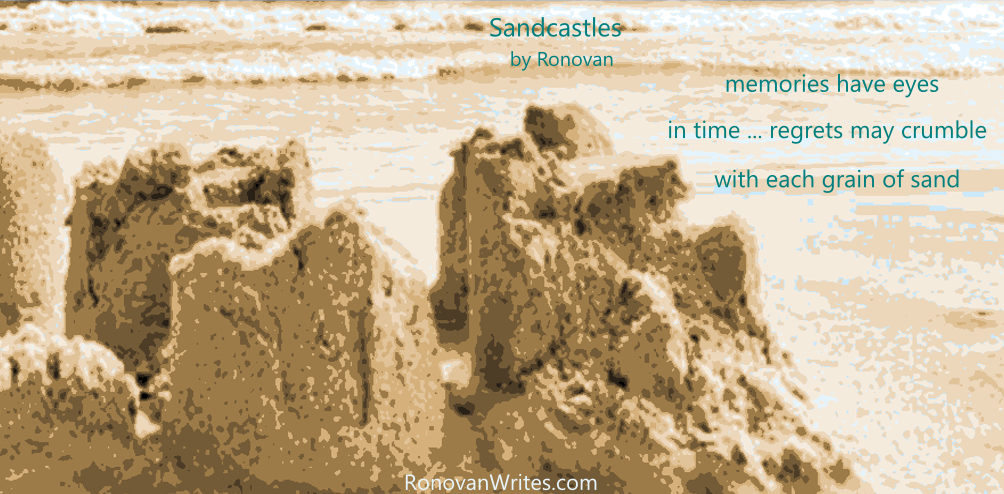
Sandcastles – A poem.

Sandcastles

memories have eyes

in time … our regrets crumble

with each grain of sand

Sandcastles Haiku image with haiku. Sandcastle on beach.

How to Write a Haiku in English Form

A haiku for this week’s Haiku Poetry Prompt Challenge of EYES and Sand.


Enter your email address to subscribe to this blog and receive notifications of new posts by email.

© 2014-2022-  Ronovan Hester Copyright reserved. The author asserts his moral and legal rights over this work.

Ronovan Writes #Weekly #Haiku #Poetry Prompt #Challenge 404 EYES and Sand .

Useful Links for Synonyms at Thesaurus.com:

EYES

Sand

To know how many syllables in a particular word try HowManySyllables.com.


An updated How to Write Haiku in English. that has just a little more detail and for knowledge and perhaps craft. And how to do a Pingback.


The Guidelines:

  1. Take the two words and write a Haiku. I use Haiku in English (the link shows you how) as my style, which is 5 syllables for the first line, 7 for the second, and 5 for the third, but you can use what you like.
    • The link above has links on how to write Haibun and Tanka. You can also do the 3/5/3 form if you like instead of the 5/7/5 that I usually use. Write, share, and have fun. For syllable help,
    • For syllables for each word, and different definitions, you use the definition that works for you Haiku. You can also use SYNONYMS. Go to Thesaurus.com for synonym help.
  2. Copy the link of your finished haiku URL and paste in a comment below so we can all go and visit your Haiku.
    • You can do a pingback. What’s a pingback? Place the URL from the address bar up top from this post as a link within your post. Your inclusion of the link encourages others to try the challenge, be creative, and join a community to find friends and more followers (hopefully). I honestly gain nothing with more people visiting the post. I don’t have ads running that generates revenue by your visit or by clicks on whatever WordPress has put up.
    • Click HERE for a detailed post on PINGBACKS.
  3. If you like, copy the image in this post and place it within their post, just to show the Haiku is part of this challenge.
      • I am not saying you need or even should, but if you would like to do so then go ahead.

Haiku Challenge

Guardians May Fall

Guardians May Fall

giants watch from high

with arms wide they cover life

bare to betrayal


This is my entry for this weeks Haiku Poetry Challenge TOWER and Watch.

There are details in the prompt on how to write Haiku.

fall haiku challenge badge japanese maple with black and white background

Enter your email address to subscribe to this blog and receive notifications of new posts by email.

© 2014-2022-  Ronovan Hester Copyright reserved. The author asserts his moral and legal rights over this work.

Destruction

Destruction

I lower my guard, allowing the enemy inside.

Destruction of life’s joys … built on untold moments of tears.

My parapet’s construction begins anew upon rubble and quicksand.


This is my entry for this weeks Sijo Poetry Challenge with theme/inspiration of GUARD.

***Not inspired by current celebrity events. Prompt challenge and poem written on Sunday.***

There are details in the prompt on how to write a Sijo, a syllable based poetry form similar to a haiku but originating in Korea.

Enter your email address to subscribe to this blog and receive notifications of new posts by email.

© 2014-2022-  Ronovan Hester Copyright reserved. The author asserts his moral and legal rights over this work.

Ronovan Writes Sijo Wednesday Poetry Challenge #3. Use GUARD as your inspiration this week.

***Prompt NOT inspired by current celebrity events. Prompt challenge and my poem written and scheduled on Sunday.***

A new form of poetry for us to try. Yes, the Décima Challenge has come to an end after 100 weeks.

Now we have the Sijo, a Korean form believed to have first been used in the fourteenth century. It is similar in structure to various Japanese forms such as Haiku. As with many forms of poetry, the Sijo became a preferred poetry form of the yangban or ruling class as well as royalty. They were written in Chinese and were originally short songs set to music. The focus of the Sijo is usually nature and contemplation. We’ll try that to begin with.

You should use the word in the title of this post as your inspiration as either a theme of the Sijo or in the poem itself.

There are:

  • Three Lines
  • 14-16 syllables per line
  • A total of 44-46 syllables for the entire poem.

To know how many syllables in a particular word try HowManySyllables.com.

  • The first line of the Sijo usually sets the theme.
  • The second line elaborates on the first line.
  • The third line brings the poem matter to a close.

The setting can be nature, a favorite season, or some event of your day. Something, as I mentioned above that can be contemplative in nature.

Within each of the three lines there is usually a pause. You can hear it in the example below. The bold sections are the parts after the pause, or at least as I read/hear them. Reading your Sijo out loud will help with using the correct form.

The following example is considered the oldest Sijo in existence,

The spring breeze melted snow on the hills then quickly disappeared.
I wish I could borrow it briefly to blow over my hair
And melt away the aging frost forming now about my ears.

If I’m counting right there are 15 syllables per line. I think that would be a good target but the pattern is up to you, as per the generally held thoughts on the matter.


As with all of the challenges that have been hosted here be sure to;

  1. Copy and past your URL into the comments below so other poets can visit and read your
  2. You can also put the link of this challenge in your post to let your followers know where to go if they want to participate. This is called a Pingback. This is not mandatory to join in or to put your post link in the comments. Click HERE to find out how to do a Pingback.
  3. Reblogging is great as well.

Ronovan Writes Sijo Challenge Image

© 2022 Ronovan Hester Copyright reserved. The author asserts his moral and legal rights over this work.

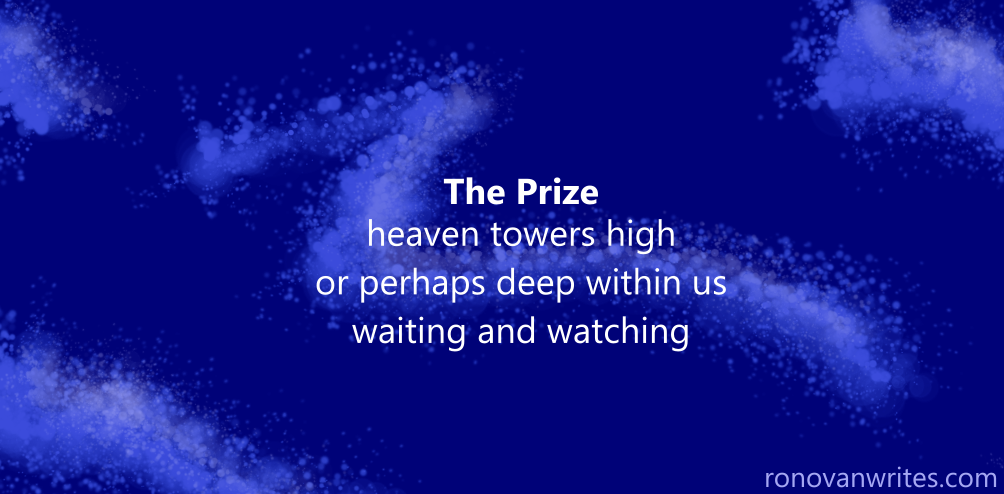
The Prize – A poem.

The Prize

heaven towers high

or perhaps deep within us

waiting and watching

The Prize Image with Haiku

How to Write a Haiku in English Form

A haiku for this week’s Haiku Poetry Prompt Challenge of TOWER and Watch.


Enter your email address to subscribe to this blog and receive notifications of new posts by email.

© 2014-2022-  Ronovan Hester Copyright reserved. The author asserts his moral and legal rights over this work.