Ronovan Writes #Weekly #Haiku #Poetry Prompt #Challenge 405 BARE and Fruit.

Yes, I mean Bare not bear.

Useful Links for Synonyms at Thesaurus.com:

BARE

Fruit

To know how many syllables in a particular word try HowManySyllables.com.


An updated How to Write Haiku in English. that has just a little more detail and for knowledge and perhaps craft. And how to do a Pingback.


The Guidelines:

  1. Take the two words and write a Haiku. I use Haiku in English (the link shows you how) as my style, which is 5 syllables for the first line, 7 for the second, and 5 for the third, but you can use what you like.
    • The link above has links on how to write Haibun and Tanka. You can also do the 3/5/3 form if you like instead of the 5/7/5 that I usually use. Write, share, and have fun. For syllable help,
    • For syllables for each word, and different definitions, you use the definition that works for you Haiku. You can also use SYNONYMS. Go to Thesaurus.com for synonym help.
  2. Copy the link of your finished haiku URL and paste in a comment below so we can all go and visit your Haiku.
    • You can do a pingback. What’s a pingback? Place the URL from the address bar up top from this post as a link within your post. Your inclusion of the link encourages others to try the challenge, be creative, and join a community to find friends and more followers (hopefully). I honestly gain nothing with more people visiting the post. I don’t have ads running that generates revenue by your visit or by clicks on whatever WordPress has put up.
    • Click HERE for a detailed post on PINGBACKS.
  3. If you like, copy the image in this post and place it within their post, just to show the Haiku is part of this challenge.
      • I am not saying you need or even should, but if you would like to do so then go ahead.

Haiku Challenge

Entry – a poem

Entry

the lion enters

walking not upon the sand

all eyes upon him


This is my entry for this weeks Haiku Poetry Challenge of EYES and Sand

There are details in the prompt on how to write a Haiku.

Enter your email address to subscribe to this blog and receive notifications of new posts by email.

© 2014-2022-  Ronovan Hester Copyright reserved. The author asserts his moral and legal rights over this work.

Destination? – a poem

Destination?

My heart’s desire fades across time and space, racing the waves.

Yet, no matter the path traveled, my passion remains full and bright.

But should desire be fuel for the attainable or the denied?


This is my entry for this weeks Sijo Poetry Challenge with theme/inspiration of PASSION

There are details in the prompt on how to write a Sijo, a syllable based poetry form similar to a haiku but originating in Korea.

Enter your email address to subscribe to this blog and receive notifications of new posts by email.

© 2014-2022-  Ronovan Hester Copyright reserved. The author asserts his moral and legal rights over this work.

Ronovan Writes Sijo Wednesday Poetry Challenge #4. Use PASSION as your inspiration this week.

A new form of poetry for us to try. Yes, the Décima Challenge has come to an end after 100 weeks.

Now we have the Sijo, a Korean form believed to have first been used in the fourteenth century. It is similar in structure to various Japanese forms such as Haiku. As with many forms of poetry, the Sijo became a preferred poetry form of the yangban or ruling class as well as royalty. They were written in Chinese and were originally short songs set to music. The focus of the Sijo is usually nature and contemplation. We’ll try that to begin with.

You should use the word in the title of this post as your inspiration as either a theme of the Sijo or in the poem itself.

There are:

  • Three Lines
  • 14-16 syllables per line
  • A total of 44-46 syllables for the entire poem.

To know how many syllables in a particular word try HowManySyllables.com.

  • The first line of the Sijo usually sets the theme.
  • The second line elaborates on the first line.
  • The third line brings the poem matter to a close.

The setting can be nature, a favorite season, or some event of your day. Something, as I mentioned above that can be contemplative in nature.

Within each of the three lines there is usually a pause. You can hear it in the example below. The bold sections are the parts after the pause, or at least as I read/hear them. Reading your Sijo out loud will help with using the correct form.

The following example is considered the oldest Sijo in existence,

The spring breeze melted snow on the hills then quickly disappeared.
I wish I could borrow it briefly to blow over my hair
And melt away the aging frost forming now about my ears.

If I’m counting right there are 15 syllables per line. I think that would be a good target but the pattern is up to you, as per the generally held thoughts on the matter.


As with all of the challenges that have been hosted here be sure to;

  1. Copy and past your URL into the comments below so other poets can visit and read your
  2. You can also put the link of this challenge in your post to let your followers know where to go if they want to participate. This is called a Pingback. This is not mandatory to join in or to put your post link in the comments. Click HERE to find out how to do a Pingback.
  3. Reblogging is great as well.

Ronovan Writes Sijo Challenge Image

Enter your email address to subscribe to this blog and receive notifications of new posts by email.

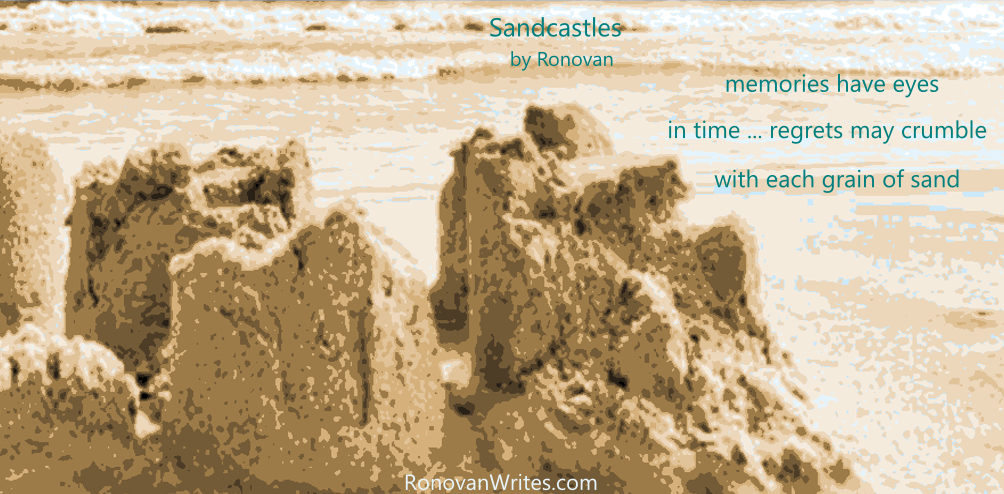
Sandcastles – A poem.

Sandcastles

memories have eyes

in time … our regrets crumble

with each grain of sand

Sandcastles Haiku image with haiku. Sandcastle on beach.

How to Write a Haiku in English Form

A haiku for this week’s Haiku Poetry Prompt Challenge of EYES and Sand.


Enter your email address to subscribe to this blog and receive notifications of new posts by email.

© 2014-2022-  Ronovan Hester Copyright reserved. The author asserts his moral and legal rights over this work.

Ronovan Writes #Weekly #Haiku #Poetry Prompt #Challenge 404 EYES and Sand .

Useful Links for Synonyms at Thesaurus.com:

EYES

Sand

To know how many syllables in a particular word try HowManySyllables.com.


An updated How to Write Haiku in English. that has just a little more detail and for knowledge and perhaps craft. And how to do a Pingback.


The Guidelines:

  1. Take the two words and write a Haiku. I use Haiku in English (the link shows you how) as my style, which is 5 syllables for the first line, 7 for the second, and 5 for the third, but you can use what you like.
    • The link above has links on how to write Haibun and Tanka. You can also do the 3/5/3 form if you like instead of the 5/7/5 that I usually use. Write, share, and have fun. For syllable help,
    • For syllables for each word, and different definitions, you use the definition that works for you Haiku. You can also use SYNONYMS. Go to Thesaurus.com for synonym help.
  2. Copy the link of your finished haiku URL and paste in a comment below so we can all go and visit your Haiku.
    • You can do a pingback. What’s a pingback? Place the URL from the address bar up top from this post as a link within your post. Your inclusion of the link encourages others to try the challenge, be creative, and join a community to find friends and more followers (hopefully). I honestly gain nothing with more people visiting the post. I don’t have ads running that generates revenue by your visit or by clicks on whatever WordPress has put up.
    • Click HERE for a detailed post on PINGBACKS.
  3. If you like, copy the image in this post and place it within their post, just to show the Haiku is part of this challenge.
      • I am not saying you need or even should, but if you would like to do so then go ahead.

Haiku Challenge

Guardians May Fall

Guardians May Fall

giants watch from high

with arms wide they cover life

bare to betrayal


This is my entry for this weeks Haiku Poetry Challenge TOWER and Watch.

There are details in the prompt on how to write Haiku.

fall haiku challenge badge japanese maple with black and white background

Enter your email address to subscribe to this blog and receive notifications of new posts by email.

© 2014-2022-  Ronovan Hester Copyright reserved. The author asserts his moral and legal rights over this work.

Destruction

Destruction

I lower my guard, allowing the enemy inside.

Destruction of life’s joys … built on untold moments of tears.

My parapet’s construction begins anew upon rubble and quicksand.


This is my entry for this weeks Sijo Poetry Challenge with theme/inspiration of GUARD.

***Not inspired by current celebrity events. Prompt challenge and poem written on Sunday.***

There are details in the prompt on how to write a Sijo, a syllable based poetry form similar to a haiku but originating in Korea.

Enter your email address to subscribe to this blog and receive notifications of new posts by email.

© 2014-2022-  Ronovan Hester Copyright reserved. The author asserts his moral and legal rights over this work.

Ronovan Writes Sijo Wednesday Poetry Challenge #3. Use GUARD as your inspiration this week.

***Prompt NOT inspired by current celebrity events. Prompt challenge and my poem written and scheduled on Sunday.***

A new form of poetry for us to try. Yes, the Décima Challenge has come to an end after 100 weeks.

Now we have the Sijo, a Korean form believed to have first been used in the fourteenth century. It is similar in structure to various Japanese forms such as Haiku. As with many forms of poetry, the Sijo became a preferred poetry form of the yangban or ruling class as well as royalty. They were written in Chinese and were originally short songs set to music. The focus of the Sijo is usually nature and contemplation. We’ll try that to begin with.

You should use the word in the title of this post as your inspiration as either a theme of the Sijo or in the poem itself.

There are:

  • Three Lines
  • 14-16 syllables per line
  • A total of 44-46 syllables for the entire poem.

To know how many syllables in a particular word try HowManySyllables.com.

  • The first line of the Sijo usually sets the theme.
  • The second line elaborates on the first line.
  • The third line brings the poem matter to a close.

The setting can be nature, a favorite season, or some event of your day. Something, as I mentioned above that can be contemplative in nature.

Within each of the three lines there is usually a pause. You can hear it in the example below. The bold sections are the parts after the pause, or at least as I read/hear them. Reading your Sijo out loud will help with using the correct form.

The following example is considered the oldest Sijo in existence,

The spring breeze melted snow on the hills then quickly disappeared.
I wish I could borrow it briefly to blow over my hair
And melt away the aging frost forming now about my ears.

If I’m counting right there are 15 syllables per line. I think that would be a good target but the pattern is up to you, as per the generally held thoughts on the matter.


As with all of the challenges that have been hosted here be sure to;

  1. Copy and past your URL into the comments below so other poets can visit and read your
  2. You can also put the link of this challenge in your post to let your followers know where to go if they want to participate. This is called a Pingback. This is not mandatory to join in or to put your post link in the comments. Click HERE to find out how to do a Pingback.
  3. Reblogging is great as well.

Ronovan Writes Sijo Challenge Image

© 2022 Ronovan Hester Copyright reserved. The author asserts his moral and legal rights over this work.

The Prize – A poem.

The Prize

heaven towers high

or perhaps deep within us

waiting and watching

The Prize Image with Haiku

How to Write a Haiku in English Form

A haiku for this week’s Haiku Poetry Prompt Challenge of TOWER and Watch.


Enter your email address to subscribe to this blog and receive notifications of new posts by email.

© 2014-2022-  Ronovan Hester Copyright reserved. The author asserts his moral and legal rights over this work.

Ronovan Writes #Weekly #Haiku #Poetry Prompt #Challenge 403 TOWER and Watch.

Did you guess what my Haiku A Maple Leaf Invader was about last week? Well the past couple of weeks have been inspired by the titles of rock n roll songs. SMOKE and Water then FREE and World.

Smoke on the Water by Deep Purple

Rockin’ in the Free World by Neil Young

As some of you may know Neil Young was Canada and has both Canadian and US citizenship. Thus we have the Maple Leaf Invader.

Useful Links for Synonyms at Thesaurus.com:

TOWER

Watch

To know how many syllables in a particular word try HowManySyllables.com.


An updated How to Write Haiku in English. that has just a little more detail and for knowledge and perhaps craft. And how to do a Pingback.


The Guidelines:

  1. Take the two words and write a Haiku. I use Haiku in English (the link shows you how) as my style, which is 5 syllables for the first line, 7 for the second, and 5 for the third, but you can use what you like.
    • The link above has links on how to write Haibun and Tanka. You can also do the 3/5/3 form if you like instead of the 5/7/5 that I usually use. Write, share, and have fun. For syllable help,
    • For syllables for each word, and different definitions, you use the definition that works for you Haiku. You can also use SYNONYMS. Go to Thesaurus.com for synonym help.
  2. Copy the link of your finished haiku URL and paste in a comment below so we can all go and visit your Haiku.
    • You can do a pingback. What’s a pingback? Place the URL from the address bar up top from this post as a link within your post. Your inclusion of the link encourages others to try the challenge, be creative, and join a community to find friends and more followers (hopefully). I honestly gain nothing with more people visiting the post. I don’t have ads running that generates revenue by your visit or by clicks on whatever WordPress has put up.
    • Click HERE for a detailed post on PINGBACKS.
  3. If you like, copy the image in this post and place it within their post, just to show the Haiku is part of this challenge.
      • I am not saying you need or even should, but if you would like to do so then go ahead.

fall haiku challenge badge japanese maple with black and white background

The Unexpected Exit Ramps of Life’s GPS.

What do we do when we know we need to make a change in life?

I’ll go ahead and say now that the reason for a change is not always caused by a bad thing. Our reason for change could simply be our realization that one thing is what we want over what we currently have or are on the path to. We may have a good job that we don’t hate, but we want one that we’re happy waking up to each day.

Many say we just need to take it one step at a time, one day at a time. Okay. I suppose they’re right up to a point. But we either have to get to their starting point or decide if we can determine what their point is. Yeah, that sentence confused me too and I’m supposed to know what I’m talking about.

To begin to find a first step we first need to realize a change is needed or required. Sometimes that change isn’t a choice but something thrown in our path. An exit ramp our GPS says we must take to continue our life because our original destination no longer exists.

That realization is a difficult thing to admit to.  Pride? Denial? Hope? Self-pity? Or maybe completely oblivious to what’s happening. Sometimes we can go through them all before hitting the reality wall. And then the hard work begins. Even with the acceptance of our situation, we know we need to figure out what to do next to get healthier.

When I said healthier I wasn’t necessarily meaning physical health. Mental, emotional, social, family, relationship, workplace, and basically anything that’s been a detour, hiccup, problem, or obstacle to happiness in our life. It could be a combination of several of those areas mentioned. Rarely is one area of our lives isolated during a swerve in life.

small, dark, hard corners

press spines into tension rods

will they break or bend

As some of you know I’ve had my share of exit ramps, thus why I found my way to blogging and poetry. But recently exit ramps were popping up on my life GPS.  I’d been off-road these past few years enough to recognize the rough terrain and eventually found my way back. Don’t get me wrong, getting back on life’s highway has taken time, and the pavement isn’t a bit bumpy but I maybe can see fresh pavement ahead. Just because I’ve been on the emotional and mental version of The Baja 1000 doesn’t mean it was any easier to make my way back or want to. It just means I knew I was there sooner than some others might have. I still had to make that decision to turn the truck around and head back to the highway.

Today is my first day of intentionally doing something to make a change in my life for the better in quite a long time. The words ‘Intentional’ and ‘Commit To’ and ‘Work the Problem’ are really annoying. They are so overused, but I do agree with doing something intentionally. If we say we are going to wake up tomorrow and drink decaf coffee instead of caffeinated but we make no preparations to do so, such as having only having caffeinated in the house instead of stocking up on decaf, then what’s likely to happen? We need to think these things through to a logical end.

That’s just one simple example.

Psalm:  “Be still, and know that I am God…”

I note the above verse because it’s one I often think of when my thoughts are in turmoil about something. It came into my life when things were a tornado of panic and difficulty. And it kept popping up all within a few days of each other in different ways from different people and many, many miles apart. Basically, the verse is saying that no matter what is happening on Earth, God has you in His hand and that once you are His you can stare difficulty in the eye and realize that no matter the end result you will ultimately end up in a place so far removed from the idea we have of a perfect that it will blow our minds.

But for me it is a way to close my eyes and just think, the world is bigger than me and I can only do what I can do. And as long as I do that then I’ve done what I can do. I may not be satisfied with it but it is what it is. I can’t worry about all those things that I have no control over even though I wish I could. I can’t bring world peace, end poverty, or world hunger with a snap of my fingers. I can donate, work at a soup kitchen, or do whatever, but I can only do my little part and be okay with that. I can only do my best at a job and the person signing the checks doesn’t like it then maybe I won’t be working for them again. But I did my best.

By doing what I can then I can have a bit of peace.  I can be still and know that God has me and I have done as God would have me do.

Maybe you are not a believer, but you can still use what you’ve read here. I only went into the  Bible verse because it helps me and it might help others. Also, it’s true that you can only do what you can do. And we need to accept that… up to a point. We should never be satisfied in some areas, such as helping the hungry and the poor. But we should be okay with what we’ve done with the idea of trying a little bit more next time. If we aren’t then we may just end up in a situation where we can’t help anyone… not even ourselves.

Until next time,

Peace, be still and do…

Ronovan

Enter your email address to subscribe to this blog and receive notifications of new posts by email.

© 2014-2022-  Ronovan Hester Copyright reserved. The author asserts his moral and legal rights over this work.

Unavoidable: a Sijo poem.

Unavoidable

Time passes with twists and turns; a relentless force.

One day the scent of life’s wind is sweet, the next sour with despair.

Will the next season be rancid or rejoiceful?


This is my entry for this weeks Sijo Poetry Challenge with theme/inspiration of Season.

There are details in the prompt on how to write a Sijo, a syllable based poetry form similar to a haiku but originating in Korea.

Enter your email address to subscribe to this blog and receive notifications of new posts by email.

© 2014-2022-  Ronovan Hester Copyright reserved. The author asserts his moral and legal rights over this work.

Ronovan Writes Sijo Wednesday Poetry Challenge #2. Use SEASON as your inspiration this week.

A new form of poetry for us to try. Yes, the Décima Challenge has come to an end after 100 weeks.

Now we have the Sijo, a Korean form believed to have first been used in the fourteenth century. It is similar in structure to various Japanese forms such as Haiku. As with many forms of poetry, the Sijo became a preferred poetry form of the yangban or ruling class as well as royalty. They were written in Chinese and were originally short songs set to music. The focus of the Sijo is usually nature and contemplation. We’ll try that to begin with.

You should use the word in the title of this post as your inspiration as either a theme of the Sijo or in the poem itself.

There are:

  • Three Lines
  • 14-16 syllables per line
  • A total of 44-46 syllables for the entire poem.

To know how many syllables in a particular word try HowManySyllables.com.

  • The first line of the Sijo usually sets the theme.
  • The second line elaborates on the first line.
  • The third line brings the poem matter to a close.

The setting can be nature, a favorite season, or some event of your day. Something, as I mentioned above that can be contemplative in nature.

Within each of the three lines there is usually a pause. You can hear it in the example below. The bold sections are the parts after the pause, or at least as I read/hear them. Reading your Sijo out loud will help with using the correct form.

The following example is considered the oldest Sijo in existence,

The spring breeze melted snow on the hills then quickly disappeared.
I wish I could borrow it briefly to blow over my hair
And melt away the aging frost forming now about my ears.

If I’m counting right there are 15 syllables per line. I think that would be a good target but the pattern is up to you, as per the generally held thoughts on the matter.


As with all of the challenges that have been hosted here be sure to;

  1. Copy and past your URL into the comments below so other poets can visit and read your
  2. You can also put the link of this challenge in your post to let your followers know where to go if they want to participate. This is called a Pingback. This is not mandatory to join in or to put your post link in the comments. Click HERE to find out how to do a Pingback.
  3. Reblogging is great as well.

Ronovan Writes Sijo Challenge Image

© 2022 Ronovan Hester Copyright reserved. The author asserts his moral and legal rights over this work.

A Maple Leaf Invader – A poem.

A Maple Leaf Invader

rock across the land

sing the words of a mad man

from a world far north


Would likely need to be my age or older to get this one.

How to Write a Haiku in English Form

A haiku for this week’s Haiku Poetry Prompt Challenge of FREE and World.

fall haiku challenge badge japanese maple with black and white background


Enter your email address to subscribe to this blog and receive notifications of new posts by email.

© 2014-2022-  Ronovan Hester Copyright reserved. The author asserts his moral and legal rights over this work.

Ronovan Writes #Weekly #Haiku #Poetry Prompt #Challenge 402 FREE and World.

Useful Links for Synonyms at Thesaurus.com:

FREE

World

To know how many syllables in a particular word try HowManySyllables.com.


An updated How to Write Haiku in English. that has just a little more detail and for knowledge and perhaps craft. And how to do a Pingback.


The Guidelines:

  1. Take the two words and write a Haiku. I use Haiku in English (the link shows you how) as my style, which is 5 syllables for the first line, 7 for the second, and 5 for the third, but you can use what you like.
    • The link above has links on how to write Haibun and Tanka. You can also do the 3/5/3 form if you like instead of the 5/7/5 that I usually use. Write, share, and have fun. For syllable help,
    • For syllables for each word, and different definitions, you use the definition that works for you Haiku. You can also use SYNONYMS. Go to Thesaurus.com for synonym help.
  2. Copy the link of your finished haiku URL and paste in a comment below so we can all go and visit your Haiku.
    • You can do a pingback. What’s a pingback? Place the URL from the address bar up top from this post as a link within your post. Your inclusion of the link encourages others to try the challenge, be creative, and join a community to find friends and more followers (hopefully). I honestly gain nothing with more people visiting the post. I don’t have ads running that generates revenue by your visit or by clicks on whatever WordPress has put up.
    • Click HERE for a detailed post on PINGBACKS.
  3. If you like, copy the image in this post and place it within their post, just to show the Haiku is part of this challenge.
      • I am not saying you need or even should, but if you would like to do so then go ahead.

fall haiku challenge badge japanese maple with black and white background

Ronovan Writes Sijo Wednesday Poetry Challenge #1. Use (BLUE) as your inspiration this week.

A new form of poetry for us to try. Yes, the Décima Challenge has come to an end after 100 weeks.

Now we have the Sijo, a Korean form believed to have first been used in the fourteenth century. It is similar in structure to various Japanese forms such as Haiku. As with many forms of poetry, the Sijo became a preferred poetry form of the yangban or ruling class as well as royalty. They were written in Chinese and were originally short songs set to music. The focus of the Sijo is usually nature and contemplation. We’ll try that to begin with.

You should use the word in the title of this post as your inspiration as either a theme of the Sijo or at least used in the poem itself. You can think of BLUE this week as how you feel, your humor, or even nature itself during spring, or the color of the ocean and how it makes you feel.

There are:

  • Three Lines
  • 14-16 syllables per line
  • A total of 44-46 syllables for the entire poem.

To know how many syllables in a particular word try HowManySyllables.com.

  • The first line of the Sijo usually sets the theme.
  • The second line elaborates on the first line.
  • The third line brings the poem matter to a close.

The setting can be nature, a favorite season, or some event of your day. Something, as I mentioned above that can be contemplative in nature.

Within each of the three lines there is usually a pause. You can hear it in the example below. The bold sections are the parts after the pause, or at least as I read/hear them. Reading your Sijo out loud will help with using the correct form.

The following example is considered the oldest Sijo in existence,

The spring breeze melted snow on the hills then quickly disappeared.
I wish I could borrow it briefly to blow over my hair
And melt away the aging frost forming now about my ears.

If I’m counting right there are 15 syllables per line. I think that would be a good target but the pattern is up to you, as per the generally held thoughts on the matter.

As with all of the challenges that have been hosted here be sure to;

  1. Copy and past your URL into the comments below so other poets can visit and read your
  2. You can also put the link of this challenge in your post to let your followers know where to go if they want to participate. This is called a Pingback. This is not mandatory to join in or to put your post link in the comments. Click HERE to find out how to do a Pingback.
  3. Reblogging is great as well.

© 2022 Ronovan Hester Copyright reserved. The author asserts his moral and legal rights over this work.

Ronovan Writes #Weekly #Haiku #Poetry Prompt #Challenge 401 SMOKE and Water.

Useful Links for Synonyms at Thesaurus.com:

SMOKE

Water

To know how many syllables in a particular word try HowManySyllables.com.


An updated How to Write Haiku in English. that has just a little more detail and for knowledge and perhaps craft. And how to do a Pingback.


The Guidelines:

  1. Take the two words and write a Haiku. I use Haiku in English (the link shows you how) as my style, which is 5 syllables for the first line, 7 for the second, and 5 for the third, but you can use what you like.
    • The link above has links on how to write Haibun and Tanka. You can also do the 3/5/3 form if you like instead of the 5/7/5 that I usually use. Write, share, and have fun. For syllable help,
    • For syllables for each word, and different definitions, you use the definition that works for you Haiku. You can also use SYNONYMS. Go to Thesaurus.com for synonym help.
  2. Copy the link of your finished haiku URL and paste in a comment below so we can all go and visit your Haiku.
    • You can do a pingback. What’s a pingback? Place the URL from the address bar up top from this post as a link within your post. Your inclusion of the link encourages others to try the challenge, be creative, and join a community to find friends and more followers (hopefully). I honestly gain nothing with more people visiting the post. I don’t have ads running that generates revenue by your visit or by clicks on whatever WordPress has put up.
    • Click HERE for a detailed post on PINGBACKS.
  3. If you like, copy the image in this post and place it within their post, just to show the Haiku is part of this challenge.
      • I am not saying you need or even should, but if you would like to do so then go ahead.

fall haiku challenge badge japanese maple with black and white background

Ronovan Writes Décima Poetry Challenge Prompt No. 100 (ROAR) in the D rhyme line.

Can’t believe I’ve done 100 weeks of these. Wondering about a new challenge on Wednesdays. I never know what I’ll do next.

ONCE YOU COMPLETE YOUR POEM PINGBACK AND/OR COPY/PASTE YOUR LINK INTO THE COMMENTS BELOW.

  • That way other people can visit your post and check out your poem.
  • You can also put the link of this challenge in your post to let your followers know where to go if they want to participate. This is called a Pingback. This is not mandatory to join in or to put your post link in the comments. Click HERE to find out how to do a Pingback.
  • Reblogging is great as well.

Some people like to copy and paste the challenge image into their posts. That’s okay with me.

Sites to help:

RhymeZone.com
Thesaurus.com
Merriam-Webster.com  Use this site for syllables. I’ve used several online counters and too many have given different counts for the same word, so I use the dictionary now. Also, in some parts of the English speaking world, the syllables may come out in the spoken language a bit differently. And that’s okay. Write to enjoy, too learn, and yes, try to get the syllables right, but above all create and enjoy.


An example of an abba/accddc décima:

On soft breeze a divine bouquet
her invitation is discrete,
to imbibe in her gifts so sweet,
and my heart with joy must obey.

Eternal beasts come into play.
Distance is an icy lover,
these shivers I cannot cover.
Time will tell the battles end.
I’ll travel along that soft wind,
to love to rediscover.

If you like, there is a Décima Challenge here each Wednesday.

Here is the quick and perhaps easier description of a Décima Poem:

I’ve had a much-valued part of my poetry family let me know that my description might not be clear enough, so I’ve come up with this. There are 10 lines (stanza) of poetry, but unlike other poetry that rhymes there is a strict set rhyming pattern, we must stick to.
In addition, each line must only have 8 syllables.
The rhyme pattern is;
a
b
b
a
a
c
c
d
d
c

But remember, if you want to be a slight bit different, you can do the four lines of abba, then the six lines of accddc.


© 2021 Ronovan Hester Copyright reserved. The author asserts his moral and legal rights over this work.


Ronovan Writes #Weekly #Haiku #Poetry Prompt #Challenge 400 FEATHER and Whisper.

400 weeks in a row. Makes one wonder how much longer I can keep coming up with 2 words per week.

Useful Links for Synonyms at Thesaurus.com:

FEATHER

Whisper


An updated How to Write Haiku in English. that has just a little more detail and for knowledge and perhaps craft. And how to do a Pingback.


The Guidelines:

  1. Take the two words and write a Haiku. I use Haiku in English (the link shows you how) as my style, which is 5 syllables for the first line, 7 for the second, and 5 for the third, but you can use what you like.
    • The link above has links on how to write Haibun and Tanka. You can also do the 3/5/3 form if you like instead of the 5/7/5 that I usually use. Write, share, and have fun. For syllable help,
    • For syllables for each word, and different definitions, you use the definition that works for you Haiku. You can also use SYNONYMS. Go to Thesaurus.com for synonym help.
  2. Copy the link of your finished haiku URL and paste in a comment below so we can all go and visit your Haiku.
    • You can do a pingback. What’s a pingback? Place the URL from the address bar up top from this post as a link within your post. Your inclusion of the link encourages others to try the challenge, be creative, and join a community to find friends and more followers (hopefully). I honestly gain nothing with more people visiting the post. I don’t have ads running that generates revenue by your visit or by clicks on whatever WordPress has put up.
    • Click HERE for a detailed post on PINGBACKS.
  3. If you like, copy the image in this post and place it within their post, just to show the Haiku is part of this challenge.
      • I am not saying you need or even should, but if you would like to do so then go ahead.

fall haiku challenge badge japanese maple with black and white background